
A homeowner in Lakeland called me on a Tuesday afternoon with a court summons on her kitchen counter and no idea what the twenty-day reply deadline meant. She’d been paying her mortgage for eleven years. One hurricane deductible, one roof claim denied, and two missed payments later, she owned a distressed property in Florida and didn’t know it yet. Let’s walk through what your actual options are.
What Is a Distressed Property in Florida?
The duplex was a distressed property in Florida even though nobody had missed a mortgage payment. Financial pressure is only one flavor of distress, so does an owner who simply can’t carry the thing anymore.
In practice, such a property in Florida is any home where the owner’s circumstances or the building’s condition prevent a normal retail sale. Think deferred maintenance that no FHA appraiser will pass. Think unpaid property taxes, code violations from the city, or a probate case nobody opened.
The definition gets its own wrinkles added by the state. Insurance is the big one. When a carrier non-renews a policy because the roof passed twenty years, the mortgage servicer force-places coverage at triple the cost, and a current homeowner slides into default inside of a year. I’ve watched that exact sequence turn solid Florida homes into distressed inventory across Polk and Charlotte counties.
Condo owners in Florida face a parallel problem with special assessments after the structural integrity reserve requirements kicked in. A unit that was worth selling in 2022 now carries a five-figure assessment attached to it.
Does your house fit? Ask yourself whether a conventional buyer with financing could close on it tomorrow without conditions. If the answer is no, you’re holding one and the standard listing advice doesn’t apply to you.
What Are the Different Types of Distressed Properties?
Writers covering this subject conflate foreclosure with distress, and that confusion costs Florida homeowners money.
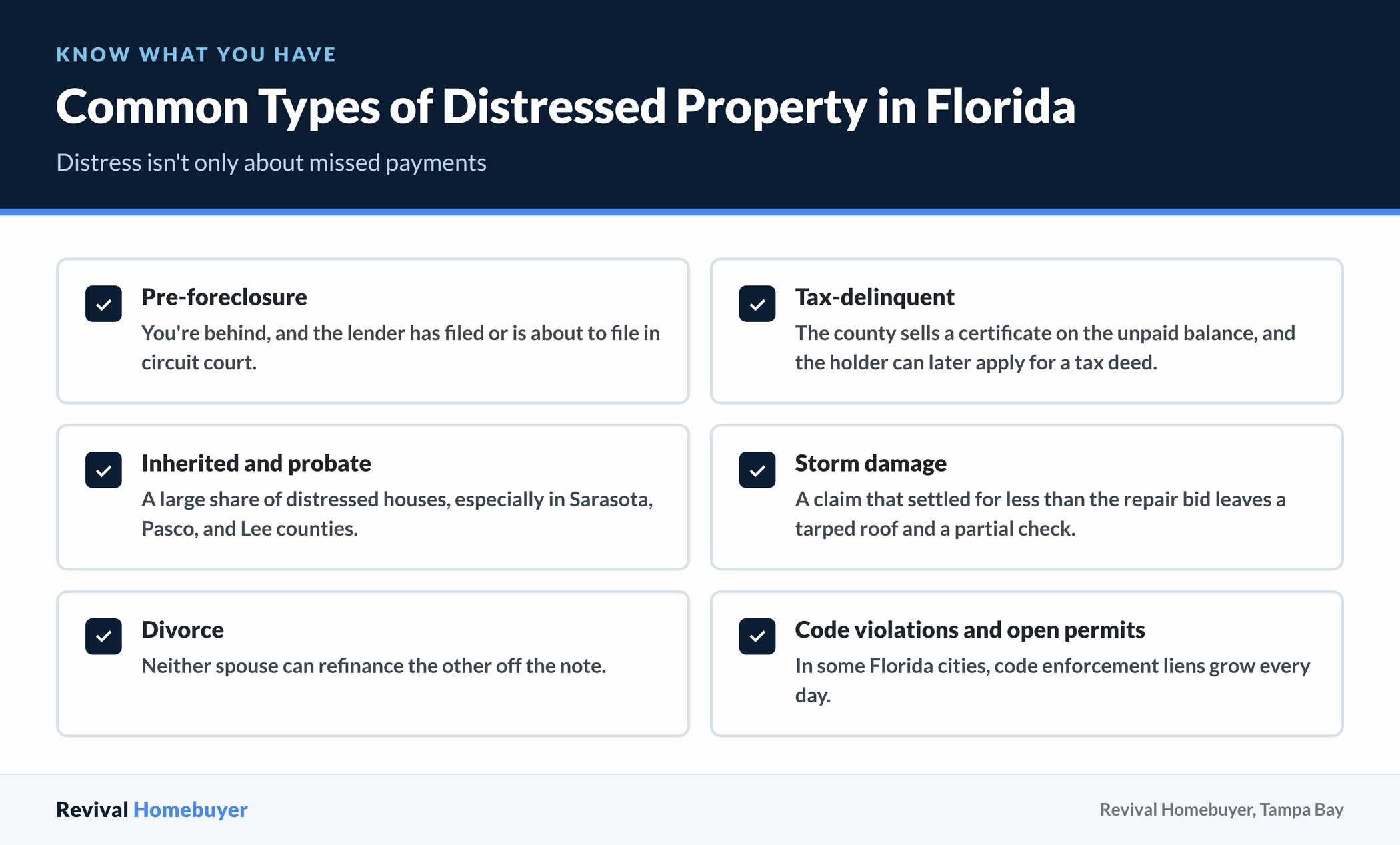
Pre-foreclosure is the category everyone knows. You’re behind, the lender has filed or is about to file, and the clock is running in circuit court.
Tax-delinquent properties form a second group. Your county tax collector sells a certificate on the unpaid balance, and the certificate holder can eventually apply for a tax deed. Your county tax collector’s office can tell you exactly where your parcel sits in that process and what it costs to clear.
Inherited and probate houses make up a huge share of the distressed volume I see in Florida, especially in retiree-heavy counties like Sarasota, Pasco, and Lee.
Storm damage earns its own spot on this list. An insurance claim that settled for less than the repair bid leaves an owner holding a tarped roof and a partial check. That’s one whether or not the mortgage is current.
Then you have the quieter types: divorce sales where neither spouse can refinance the other off the note, rental properties trashed by a tenant, hoarding situations, and houses with open permits the owner inherited from a contractor who vanished, and in some Florida municipalities code enforcement liens accrue daily and can outgrow the house’s value.
The dirt under a condemned Florida house in a decent school zone still has real buyers.
Why Do Investors Buy Distressed Properties in Florida?
A conventional buyer brings an appraisal, an inspection, a lender underwriter, and an insurance binder that might not materialize. Remove all four and the deal becomes predictable, and predictability is worth real money in such a transaction.
Florida’s numbers explain the rest. ATTOM’s midyear report, published in July 2026, counted 27,494 Florida properties with foreclosure filings in the first six months of 2026. This was roughly one in every 373 housing units and the worst rate in the country. Filings ran 33% above the same stretch of 2025.
The other half is that Florida’s retail market got slower. Statewide, listings sat a median of 81 days in September 2026, with about one in five carrying a price cut. This slower pace widens the gap between what a flipper pays and what they later sell for, so investor activity rises right alongside distress.
Insurance underwriting drives more such acquisitions in Florida than any other factor outside of the mortgage itself. Florida cash buyers don’t need a carrier to approve a 22-year-old shingle roof before closing, but retail buyers do, and that single requirement kills Florida deals weekly.
Flood zone lines in Hillsborough. Which Pinellas neighborhoods got substantial-damage letters after a surge. Which Brevard municipalities actually enforce their lien schedules. That knowledge is the whole edge.
Worth saying plainly: don’t sign every investor offer on a distressed property. Get two or three, compare them, and read the assignment clause.
How Fast Can You Lose a Distressed Property to Foreclosure in Florida?
Miss the window and you don’t just lose the house; you lose the equity sitting inside it, because an auction bidder has no reason to pay you a penny over the debt.
Florida is a judicial foreclosure state. A lender can’t take your home through a private trustee sale here; it has to file a lawsuit, prove its case, and get a judgment before any sale happens.
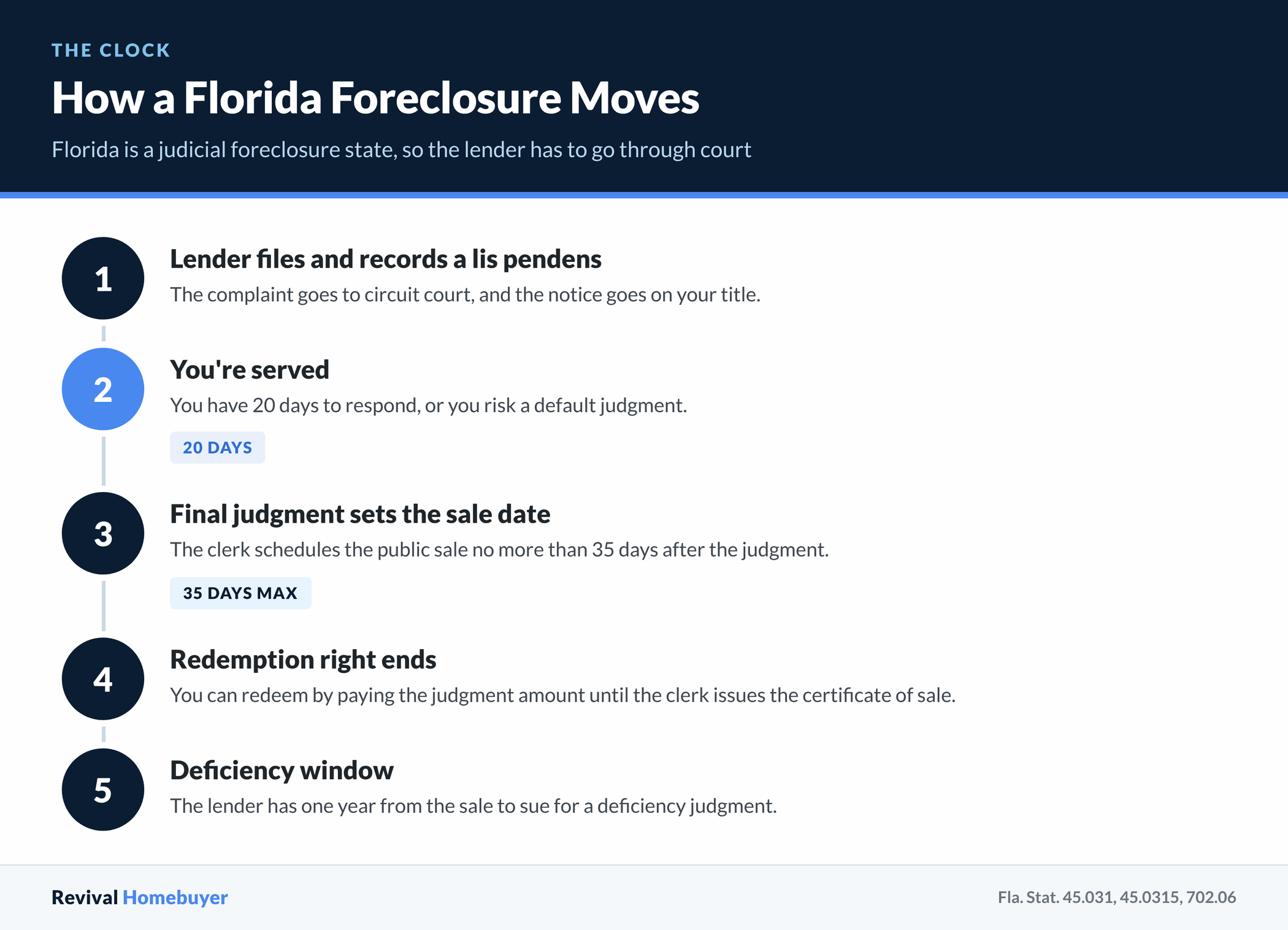
Here’s the sequence. The lender files a complaint in circuit court and records a lis pendens against your title. Once you’re served, you have 20 days to respond or risk a default judgment handed to the lender. Many Florida homeowners never answer at all. A default is the fastest possible path to losing a distressed property, and it’s entirely self-inflicted.
If the lender wins, a final judgment sets the sale date. Florida Statute § 45.031 directs the clerk to schedule that public sale within a specific window and no more than 35 days after the judgment. Under Florida Statute 45.0315 you can still redeem by paying what the final judgment specifies, but that right ends when the clerk issues the certificate of sale. After the sale, the state gives no statutory right of redemption.
Properties foreclosed nationally in the first quarter of 2026 had averaged 577 days in the process. Lenders are moving faster now, and uncontested Florida cases close in a fraction of that time.
One more thing worth knowing before you let it go to auction. Under Florida Statute § 702.06, a lender has one year from the foreclosure sale to file a separate suit for a deficiency judgment. For an owner-occupied home that deficiency is capped at the judgment amount minus the property’s fair market value on the sale date.
What Are the Most Common Ways to Sell a Distressed Property in Florida?
“Can I still sell if the bank already filed?”
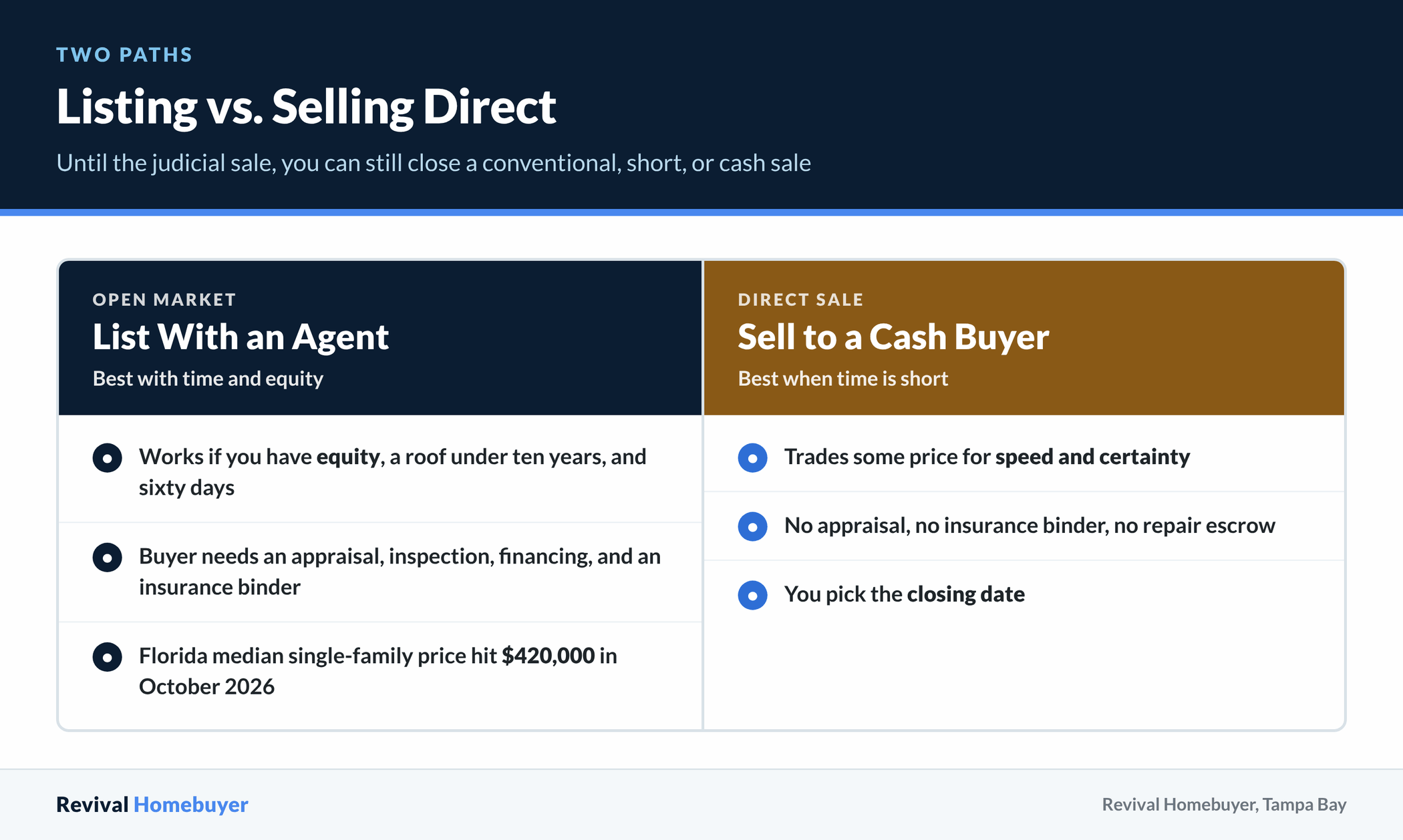
Yes. A recorded lis pendens doesn’t make selling a Florida house in foreclosure illegal or impossible; the practical deadline is the judicial sale. Until that hammer falls, you can close a conventional sale, a short sale, or a cash sale.
Plenty of distressed property owners are still right to list with an agent, and I say that as someone who buys houses. If you have equity, a roof under ten years, and sixty days before anything bad happens, list it.
The catch in Florida is the calendar. In October 2026 the statewide median single-family price hit $420,000, up 2.2% year over year, with inventory at a 4.6-month supply. Rising prices don’t help you if your listing needs three months to find a buyer and your sale date lands in six weeks.
They work for clean land and vacant houses, less so for occupied distressed property where a buyer wants interior access.
Selling direct to a cash buyer trades price for speed and certainty. What you get instead: no appraisal, no insurance binder, no repair escrow, and a closing date you choose. I’ve seen this play out with sellers facing a judgment pending, and for that kind of distressed property, the tradeoff often pencils out.
Count them honestly before you pick.
What Is a Short Sale and How Does It Work?
If the payoff is bigger than the house is worth, you’re not selling the house; you’re negotiating with the bank and the house is just the collateral.
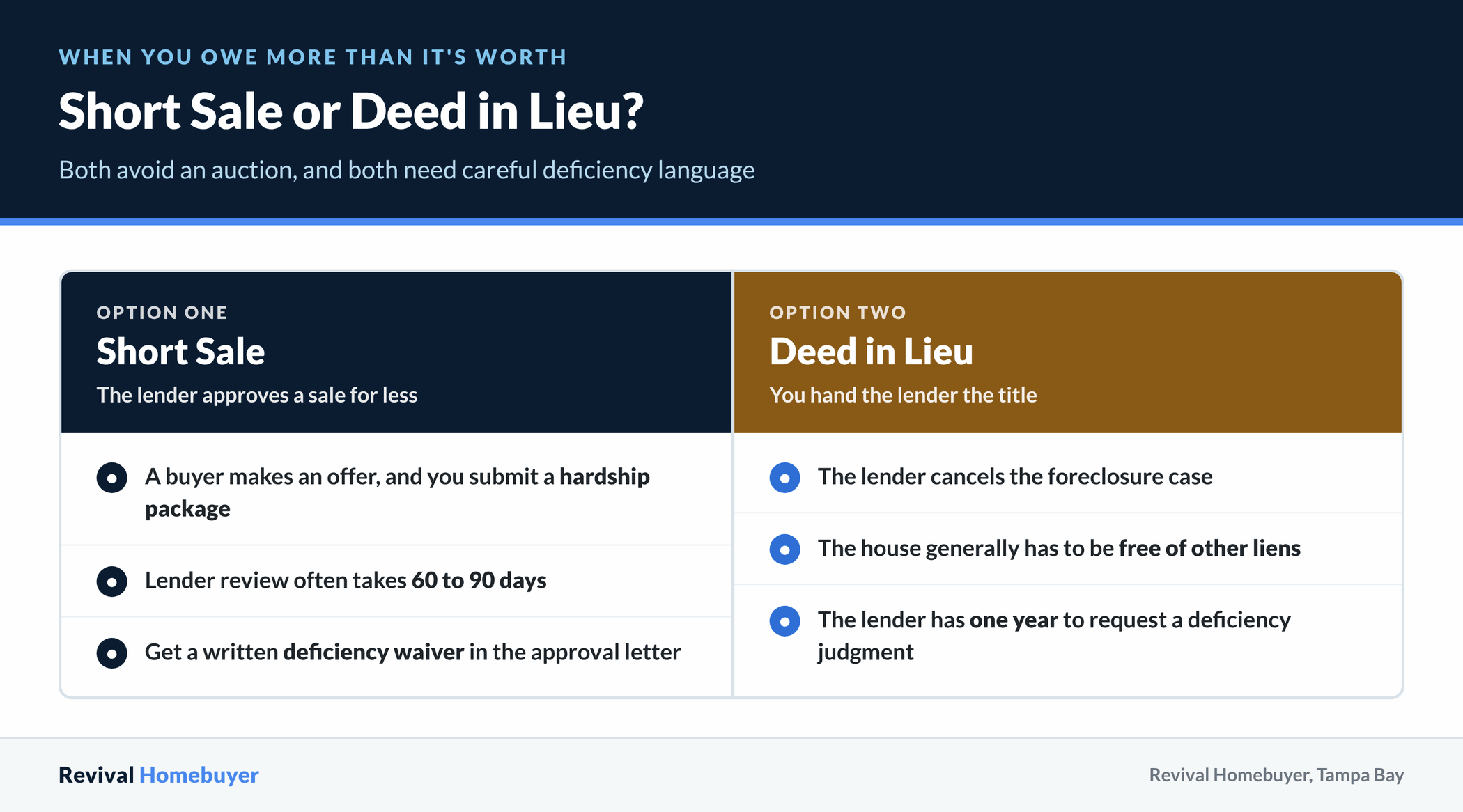
The buyer makes an offer, you submit a hardship package, and an asset manager at the servicer decides. Florida short sales commonly take sixty to ninety days just for lender review, sometimes longer with two mortgages involved.
Weak hardship letters sink more Florida short sales than bad pricing does. Write it plainly.
Pay close attention to one thing most short sale discussions skip. The one-year deficiency deadline applies to foreclosure sales and deeds in lieu. Short sales appear nowhere in that limitation statute. So two Florida appellate courts have held a short sale doesn’t start the one-year clock. So get a written deficiency waiver in the approval letter before you sign anything.
Second lienholders complicate Florida short sales more than anything else.
Investors with other deals walk after week six. That’s why pairing a short sale with a patient local buyer matters. Revival Homebuyer have sat through bank reviews on distressed property files across Hillsborough and Pasco. They know when a servicer is stalling versus when a file is genuinely dead.
What Is a Deed in Lieu of Foreclosure?
A Clermont couple I spoke with had a house with one mortgage, no equity, no second lien, and a mother-in-law suite that nobody had permitted. Six weeks after they signed the deed over to the servicer, they were renting a townhome near Winter Garden with their credit bruised but no judgment hanging over them.
A deed in lieu is exactly what it sounds like: you hand the lender the title voluntarily and they cancel the foreclosure case. No auction, no clerk’s sale, no public bidding on your distressed property.
The house generally has to be free of other liens, since the servicer inherits whatever is recorded against the title. One code enforcement lien from a Florida municipality or an old HOA judgment and the file dies. Most servicers also want the house listed for a stretch first, to show it wouldn’t sell.
Watch the deficiency language here as carefully as you would in a short sale. For Florida residential property with up to four units, a lender has one year from acceptance of a deed in lieu to request a deficiency judgment. A servicer that won’t put it on paper is telling you something.
Many national servicers pay moving money on deed-in-lieu files in Florida, and homeowners who never ask never get it.
If your Florida distressed property has any spread between its value and the payoff, selling captures that spread and a deed in lieu donates it to the bank.
A couple in Deltona learned this the slow way. They listed with one agent for six months and got nothing. They relisted with a second, and watched that expire too with zero offers on a three-bedroom with a sagging carport and a garage full of their son’s restaurant equipment. Two expired listings later they finally sold the distressed property direct in under three weeks, which is roughly what the second listing agreement had left on it anyway.
Frequently Asked Questions About Selling a Distressed Property in Florida
How Do You Figure Out What a Distressed Property Is Worth?
Work backward from what the house would sell for fully repaired in that specific Florida neighborhood, then subtract the repair cost, the carrying costs, and the buyer’s profit. A roof, an AC system, and an electrical panel are the three line items that swing Florida numbers hardest. Pull three recent comparable sales within a mile and adjust for condition; a distressed property never appraises against renovated comps, so don’t price it that way.
Will Selling a Distressed Property in Florida Wreck My Credit?
Selling before a judgment is entered generally hurts far less than letting the case run to a clerk’s sale. A completed foreclosure stays on your report for years; a sale that pays off the loan doesn’t register as a default at all. Short sales and deeds in lieu land somewhere in between, which is one more reason to move early rather than wait.
Can I Sell a Distressed Property in Florida with Liens Against It?
Yes, and most distressed property sales in Florida involve at least one lien beyond the mortgage. Code enforcement liens, HOA assessments, contractor claims, and tax certificates all get addressed at closing out of the proceeds. A good title company will order the payoffs and negotiate reductions on some of them, especially municipal liens where the fine has grown past anything reasonable.
If you’re staring at a court date, a tarped roof, or a house you inherited and can’t carry, talk it through with someone before the calendar decides for you. We’re happy to look at your situation and tell you honestly whether listing, a short sale, or a direct sale makes the most sense, even if the answer means you don’t need us. Reach out whenever you’re ready, no pressure and no obligation.
Get Honest Answers About Your Distressed Property
If your house is behind on payments, damaged, or stuck in probate, you can contact Revival Homebuyer and tell us what’s going on. Prefer to type it out? Use the form below, and we’ll follow up with options that fit your timeline.