
A deed in lieu can be a clean exit or a trap door. The difference usually comes down to a few sentences buried in the agreement. I’ve sat at kitchen tables from Pasco County to the Treasure Coast with folks who thought they’d settled everything, only to learn the bank had reserved its rights. Homeowners in Florida are under real pressure right now, and the paperwork deserves more attention than it usually gets.
What Is a Deed in Lieu of Foreclosure in Florida?
Hand the bank your deed without a written release of the remaining debt, and you’ve given away your only leverage.
A deed in lieu is a voluntary transfer. You sign the property over to your mortgage lender. In exchange, the lender agrees to stop the foreclosure case or never start it.
Florida is a judicial foreclosure state, so every foreclosure runs through a circuit court judge. Homeowners get the right to defend themselves, present evidence and challenge the lender’s case. It also means months of waiting. Signing a deed in lieu skips the courtroom and trades that time for a faster, quieter handoff.
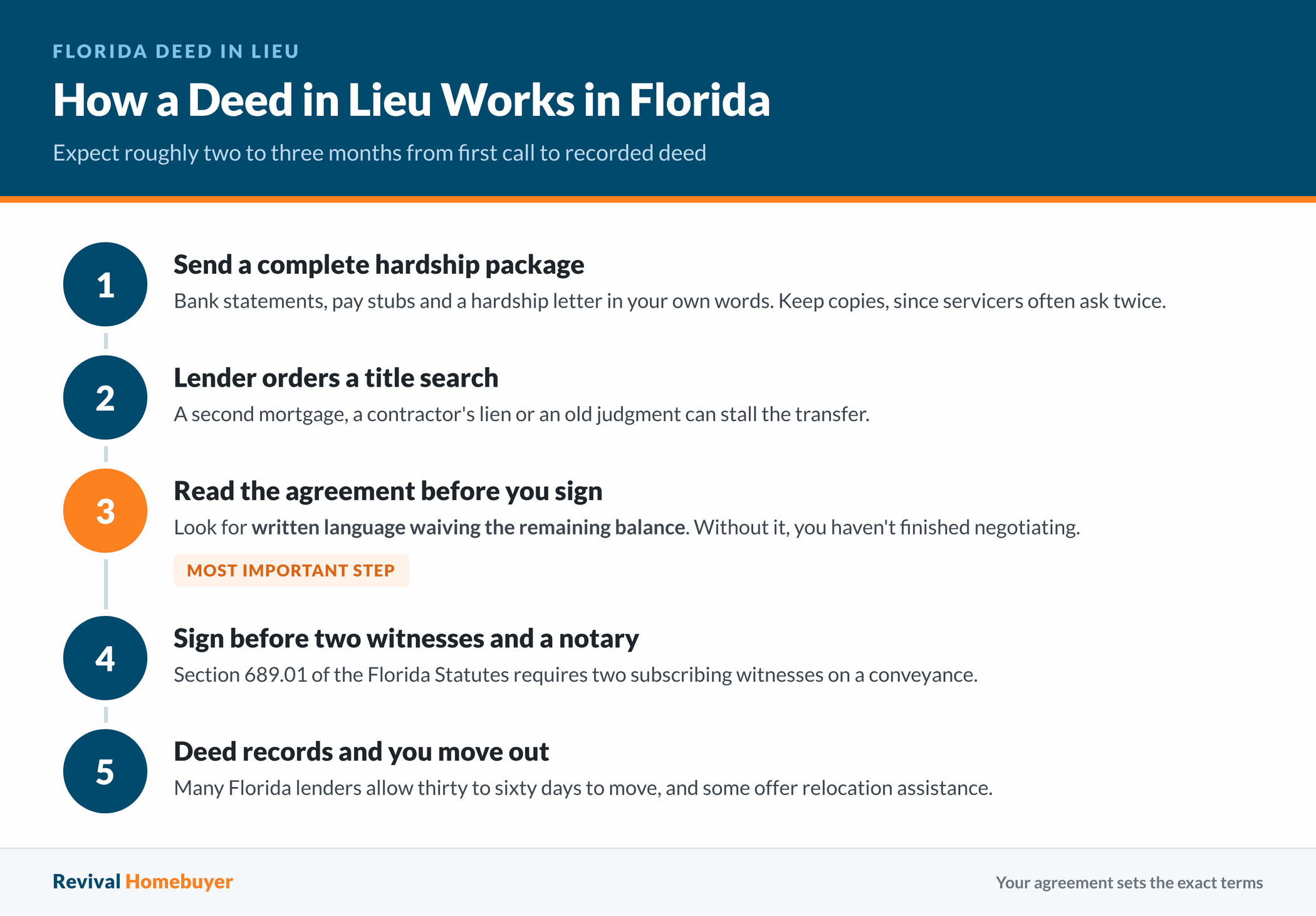
Execution matters here more than in most states. Under section 689.01 of the Florida Statutes, a conveyance of real property has to be in writing and signed in the presence of two subscribing witnesses, who sign as well. Notarizing it is a separate step. Sign it in a hurry at a kitchen counter with one neighbor watching, and it isn’t going to hold up. Your county’s clerk of the circuit court can answer questions about recording it.
What a deed in lieu is not: a reset button. Your credit still takes a hit. In most cases the lender still reports the loan as settled for less than the full amount.
Do You Qualify for a Deed in Lieu of Foreclosure in Florida?
A widow in Zephyrhills called me a few years back. She was well behind on the loan, with an auction date already on the calendar and her late husband’s fishing boat still parked in the carport. Six weeks later she’d moved in with her daughter in Brandon, with cash in hand and no judgment hanging over her.
Qualification isn’t automatic. For the most part, Florida lenders want to see a documented hardship: job loss, medical bills, divorce or the death of a co-borrower. They’ll ask for bank statements, pay stubs and a hardship letter in your own words.
Clear title is the real gatekeeper. A second mortgage, a contractor’s lien or an old judgment sitting behind your first lender usually stalls a deed in lieu. Banks prefer the court route for exactly this reason when the title’s messy.
Lenders also want proof you tried to sell first, since listing at fair market value for a reasonable stretch shows good faith. Give that step realistic time. In September 2026, single-family homes statewide took a median of 87 days from listing to closing, according to Florida Realtors.
Investment property owners get approved less often, and the terms they’re offered tend to be worse.
Being behind but not yet sued puts you in the strongest spot you’ll ever have to negotiate. Waiting until the summons arrives shrinks your options fast.
How Does a Deed in Lieu of Foreclosure Work in Florida, Step by Step?
Plenty of homeowners picture a single appointment: show up, sign, drop off the keys and finish by lunch. In practice it’s closer to two or three months of document requests. Loss mitigation departments rarely move on your schedule. Expect repeat requests for the same financial documents, so keep copies of everything you send.
Your loan servicer assigns a single point of contact, at least in theory.
Next comes the title search. The lender orders it, reads it and decides whether anything in the chain kills the transfer. Older Florida properties, especially in St. Augustine or the older sections of Lakeland, turn up surprises. I’ve seen unreleased mortgages from the 1990s, heirs nobody knew about and open permits from a sunroom addition.
When the numbers work, the bank drafts the agreement. Your attention belongs on this document, so read the release language twice. If it doesn’t say in plain words that the lender waives its right to pursue you for any remaining balance, you haven’t finished negotiating. I’ve watched sellers sign relocation-assistance addenda without reading the deficiency paragraph above it. It’s the paragraph that follows you around.
Closing happens at a title company or an attorney’s office. You sign the deed before two witnesses and a notary, then hand over keys and garage remotes. Afterward, the lender records the transfer with the county clerk. Move-out dates are negotiable, and many Florida lenders allow thirty to sixty days, though your agreement sets the number.
Will a Florida Lender Accept a Deed in Lieu of Foreclosure?
Taking a deed means taking the property, the insurance premium, the HOA dues in that Kissimmee subdivision and the roof that’s eight years past its warranty. The lender has to weigh that whole package. Insurance costs alone make some lenders hesitate to take back a Florida house.
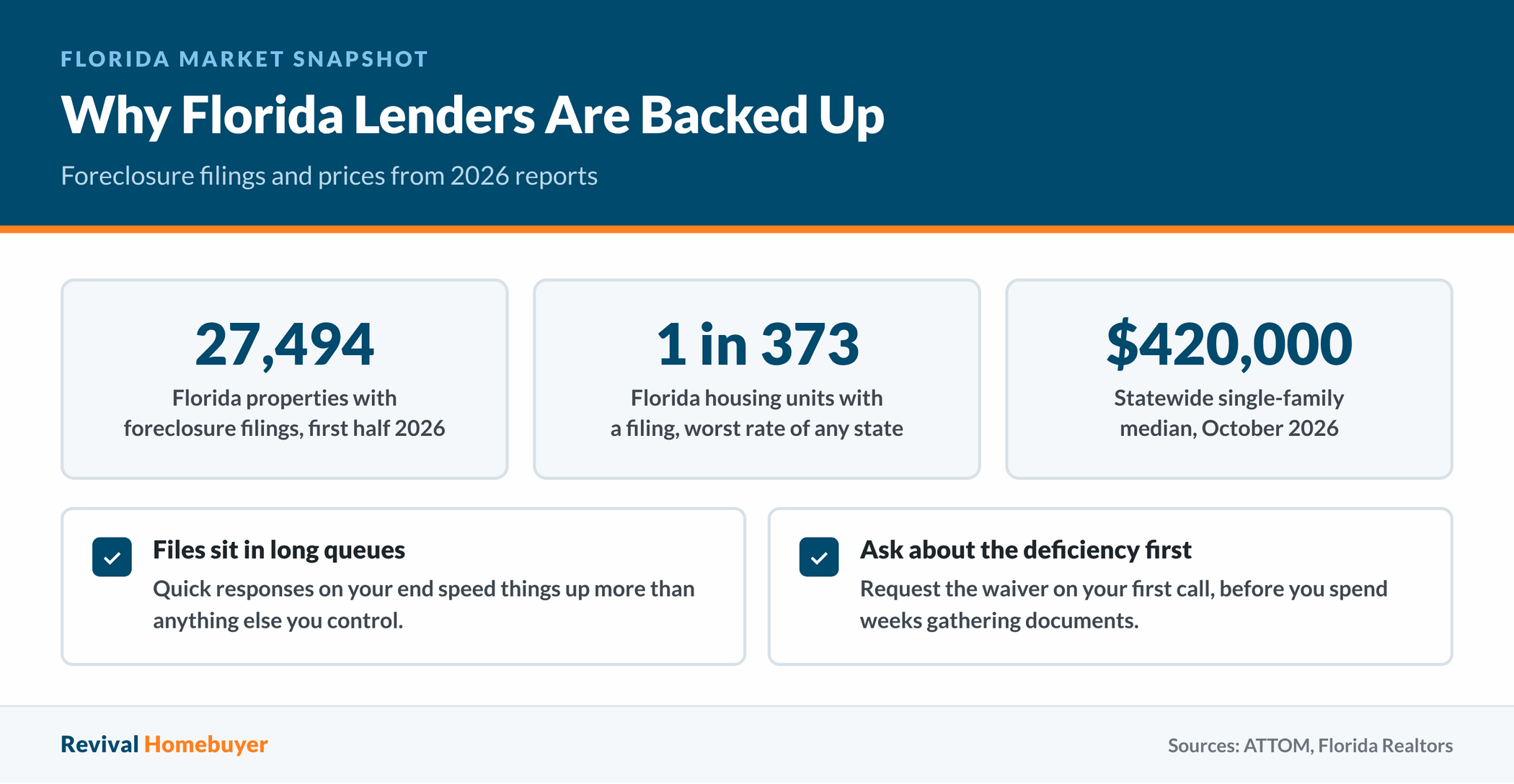
The volume pressure is real. In the first half of 2026, Florida recorded 27,494 properties with foreclosure filings, or one in every 373 housing units, according to ATTOM’s midyear foreclosure report. That’s up 32.7 percent year over year and the worst rate of any state. Loss mitigation departments are buried, so your file sits in a queue behind thousands of others. Quick responses on your end speed things up more than anything else you control.
Government-backed loans follow their own playbooks. FHA, VA and USDA servicers have formal programs for this option, with published eligibility standards and sometimes relocation assistance attached. Conventional loans sold to Fannie Mae or Freddie Mac have their own criteria. In my experience, those investor rules get applied less consistently than the FHA guidebook suggests. Portfolio lenders, the small Florida banks and credit unions that kept your loan in-house, have the most flexibility of anyone.
Ask whether your lender will release the deficiency on your very first phone call, before you spend six weeks gathering documents. Lenders in Florida can and do waive it, but you’ve got to request it in writing and get it in writing.
Some homeowners find the answer is no and that a straight sale nets them more. If you want someone to run that math with you honestly, Revival Homebuyer has walked a lot of Florida families through the comparison. We won’t push a listing agreement on you to do it.
What Are the Advantages of a Deed in Lieu of Foreclosure for Florida Homeowners?
Beyond avoiding the court docket, the biggest advantage is control over the calendar. You pick the move-out date instead of learning it from a clerk’s notice taped to your door.
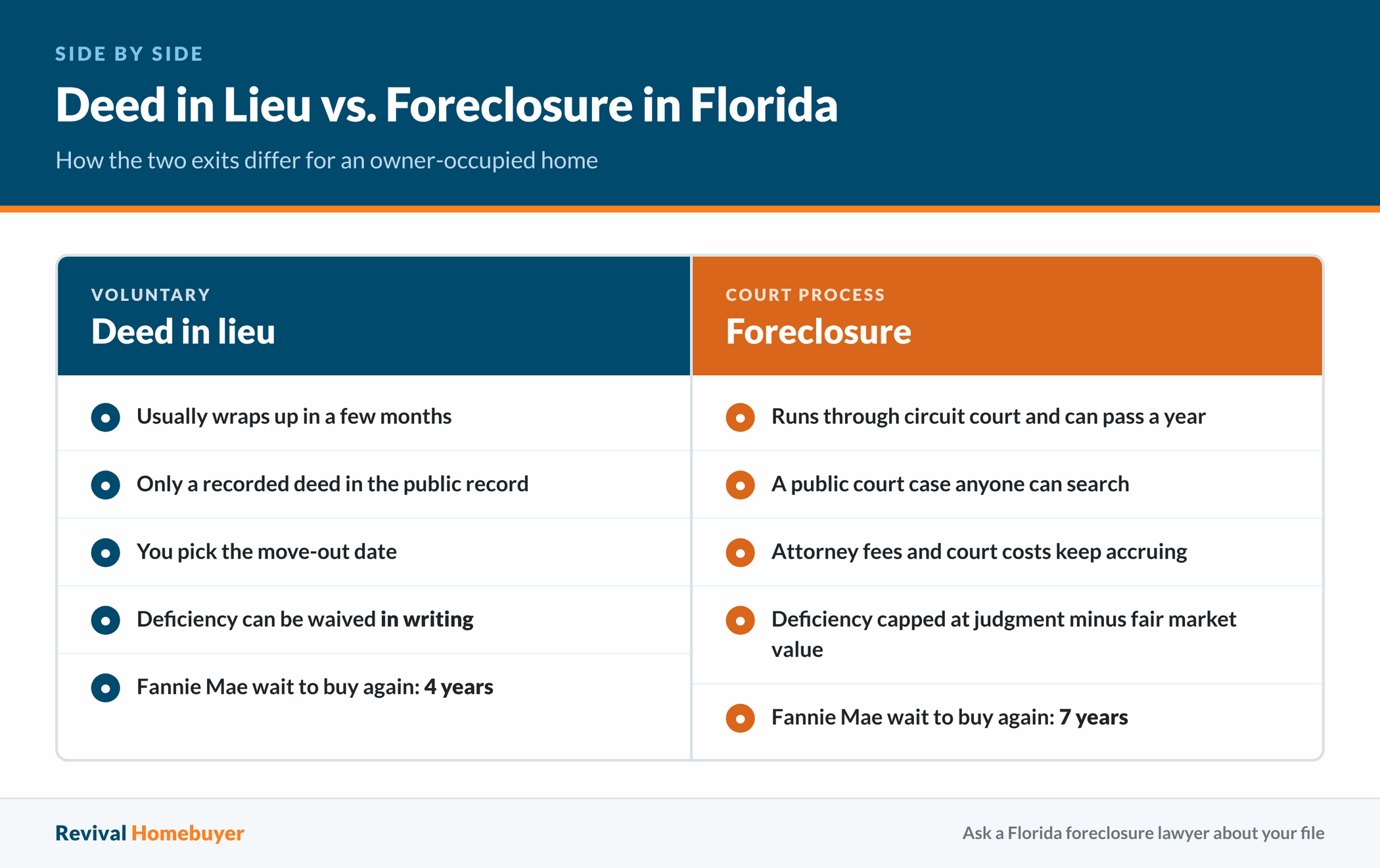
Privacy counts for more than people admit. Florida foreclosure cases are public record, searchable by anyone with your name and a browser. Neighbors notice. With a deed in lieu, the only public trace is a recorded deed.
Credit recovery tends to come faster. A completed foreclosure judgment sits on your report as a legal action. Your deed in lieu often reports as a settled account instead.
Cash for keys is the advantage nobody expects. Many servicers offer relocation assistance to homeowners who leave the property broom-clean and on schedule. An empty, undamaged house is worth more to them than a trashed one.
You also stop the bleeding on attorney fees and court costs that get added to your balance during a contested foreclosure. In a judicial state like Florida, those charges accrue for as long as the case runs.
The emotional math matters too. Sitting through hearings in a Hillsborough or Duval County courtroom while a lawyer explains why you fell behind takes something out of a person. I’ve watched it happen to homeowners more than once. Negotiating a quiet handoff lets you keep your dignity and your weekends.
Deed in Lieu of Foreclosure Vs. Foreclosure: Which Is Better?
Four hundred twenty thousand dollars. That was the statewide median single-family sale price in October 2026, up 2.2 percent from a year earlier, according to Florida Realtors’ October report. If your mortgage balance sits near or above that figure, the choice between a deed in lieu and a contested foreclosure changes shape completely.
Equity is the deciding factor. Have some? Fighting the foreclosure or selling outright almost always beats handing the deed to the bank, because a deed in lieu gives up whatever cushion you’ve built. Underwater with no realistic path to catch up? The calculus flips.
Time works differently in each. Florida foreclosures run through the courts and can stretch past a year when a homeowner mounts a defense. For some that means free occupancy, and for others it means months of anxiety. Most deed in lieu files wrap up in a few months.
Deficiency exposure deserves a careful look in both directions. On an owner-occupied home, section 702.06 caps a deficiency judgment at the gap between the judgment amount and the property’s fair market value on the date of sale, not the auction price. Timing has its own rule. Section 95.11 gives a lender one year to sue for a deficiency judgment on a one to four family home. The clock starts the day after the clerk issues the certificate of title, or the day after the lender accepts a deed in lieu. Ask a Florida foreclosure lawyer to review your file against both rules.
My stance, after years of this: a deed in lieu is better when the lender puts a full deficiency waiver in writing, and worse when it doesn’t. That one clause outweighs everything else on the list. The rest is details.
What Are Your Alternatives to a Deed in Lieu of Foreclosure?
For years I told homeowners a short sale was the slower route. I was wrong often enough to stop saying it. A short sale can move quickly once the bank’s approval comes through, and it gives you more say over who buys the house.
Loan modification comes first for most families. If your income has recovered and the arrears are the only problem, a modification folds the past-due amount back into the loan and keeps you in the house. Call your servicer’s loss mitigation line, not the general customer service number.
Family money, a 401(k) loan or a second job has saved more Florida houses than any legal strategy.
A traditional sale works when you have equity and time. Florida’s single-family inventory reached a 4.6 month supply in October 2026, up from 4.4 months in September. Buyers have choices, so a distressed listing needs to be priced right.
These routes take patience, and the deficiency question comes up here too.
Selling directly to a cash buyer closes fastest when an auction date is already set. There’s no appraisal contingency, no financing fallout and no repairs to a roof the insurer flagged last hurricane season. Revival Homebuyer buys Florida houses in that situation regularly. Talking it over costs nothing, even if you end up choosing a different path.
Bankruptcy stops a foreclosure sale immediately through the automatic stay. If a sale date is only weeks away, talk to a Florida bankruptcy attorney before anything else.
What Happens After a Deed in Lieu of Foreclosure?
So what does life look like the Monday after you hand over the keys?
Cancel your homeowners policy, forward your mail and keep a copy of the recorded deed somewhere safe.
Tax consequences depend on your situation. The IRS can treat forgiven mortgage debt as taxable income. Florida has no state income tax, so the federal return is the one that matters. Under IRS Publication 4681, the old principal residence exclusion doesn’t cover debt forgiven under agreements made after 2025. The insolvency exclusion is the one to ask about. One meeting with a Florida CPA will tell you whether you owe anything, and it’s worth the fee.
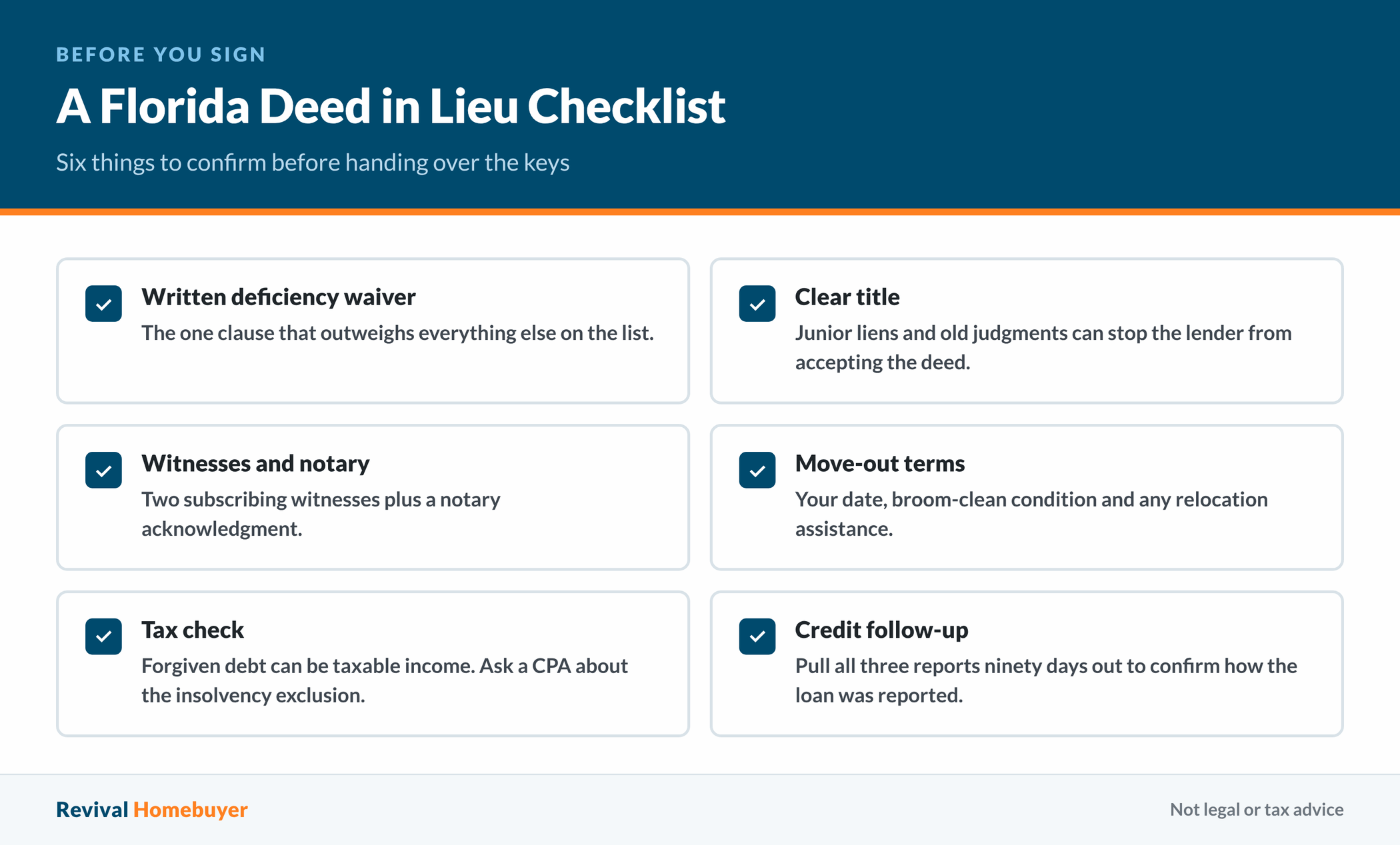
Expect a dip, and expect it to heal. Pull your reports from all three bureaus ninety days out to confirm the lender reported it the way your agreement said it would.
Renting again in Florida takes planning. Landlords in competitive markets like Sarasota and Winter Park run credit, and a recent deed in lieu will surface. Offer an extra month’s deposit and a short written explanation. Property managers I know respond better to candor than to a scrubbed application.
A man in Port Charlotte called me on a Wednesday afternoon with a deed in lieu agreement already drafted. He mentioned the new pool pump and the newer roof, and once we ran the numbers the house still had real equity. We bought it instead, and he kept the difference rather than handing it to his lender.
You can buy again, and the wait is shorter than after a foreclosure. Fannie Mae’s guidelines set a four-year waiting period after a deed in lieu, compared with seven years after a completed foreclosure. FHA rules work differently, so ask a Florida loan officer for the current seasoning requirements before you write yourself off.
Frequently Asked Questions About Deed in Lieu of Foreclosure in Florida
Does a Deed in Lieu Need Two Witnesses in Florida?
Yes. A deed in lieu is a conveyance like any other, so the execution rules described earlier apply in full. Missing a witness or the notary can make the transfer defective and give the lender a reason to delay recording it. Your title company or closing attorney normally supplies them, so ask who’s providing them before closing day.
How Long Does a Deed in Lieu of Foreclosure Take to Process in Florida?
Plan on a couple of months from the day you submit a complete hardship package to the day the deed records. Title issues and lender backlogs stretch that timeline, not your paperwork, as long as you send everything the first time. If your servicer sits on a file for weeks without an answer, ask in writing for the name and extension of your single point of contact.
How Long Can You Go Without Paying Your Mortgage Before Foreclosure Starts in Florida?
Federal servicing rules generally bar a servicer from making the first foreclosure filing until the loan is more than 120 days past due, though your mortgage documents govern the specifics. After that, the lender files suit in circuit court and you’re served. Because a judge has to be involved, you still have time and defenses once the case starts. Every month that passes adds fees to your balance, though.
Does a Florida Foreclosure Wipe Out All Liens on the Property?
Not all of them. A foreclosure generally extinguishes junior liens recorded after the mortgage being foreclosed, which is why second mortgages and later judgments often get cleared. Senior liens, property taxes and certain government claims typically survive the sale. That’s also why lenders sometimes refuse a deed in lieu on a property with messy title, since taking the deed means taking those junior liens with it.
Can I Negotiate a Deficiency Waiver Into a Deed in Lieu of Foreclosure in Florida?
You can, and you should treat it as the central term rather than a nice-to-have. Ask for it on the first call, request it in writing and have a Florida real estate attorney read the final agreement before you sign anything. Without a written release, a deed in lieu leaves the door open for the lender to pursue the remaining debt within the statutory window.
Is a Deed in Lieu of Foreclosure Better Than Just Selling the House?
It depends on equity. If your Florida home is worth more than you owe, selling almost always puts money in your pocket that a deed transfer simply erases. For an underwater owner with the clock running, the comparison gets closer. A direct cash sale sometimes still beats both options because it closes on a date you choose.
Tampa Homeowners Weighing a Deed in Lieu
Revival Homebuyer is based in Tampa and buys houses across Hillsborough, Pasco and Pinellas counties. Single-family homes across the Tampa Bay metro sold for a median of $405,495 in October 2026, according to Florida Realtors. That number is why so many Tampa homeowners still have equity worth protecting before they sign anything.
We also buy houses well beyond the bay, so sellers elsewhere in Florida can run the same comparison with us.
Talk Through Your Deed in Lieu Options in Florida
If you’re somewhere in the middle of all this and want to talk it through with someone who won’t push you toward one answer, reach out to Revival Homebuyer. We’ll look at your numbers and tell you honestly whether a deed in lieu, a sale or staying put makes the most sense for your Florida situation. When the answer is none of the above, we’ll tell you that too. No pressure, no obligation and no cost for the conversation. Fill out the short form below to get started.