
A title search came back on a Port Charlotte bungalow last spring with a recorded notice that stopped the closing cold. She had no idea her contractor had sued over an unpaid invoice eight months earlier. From that day on, the clerk’s record carried that pending lawsuit forward into every title search. She still sold. It just took a different route than the one she’d planned.
Owning a Florida property with a pending lawsuit against it changes the mechanics of a sale without ruling one out.
What Does a Pending Lawsuit Mean for Your Florida Property Sale?
Even a small contractor dispute in Tampa can sit on a title for months if nobody resolves it. So does a lawsuit freeze your house?
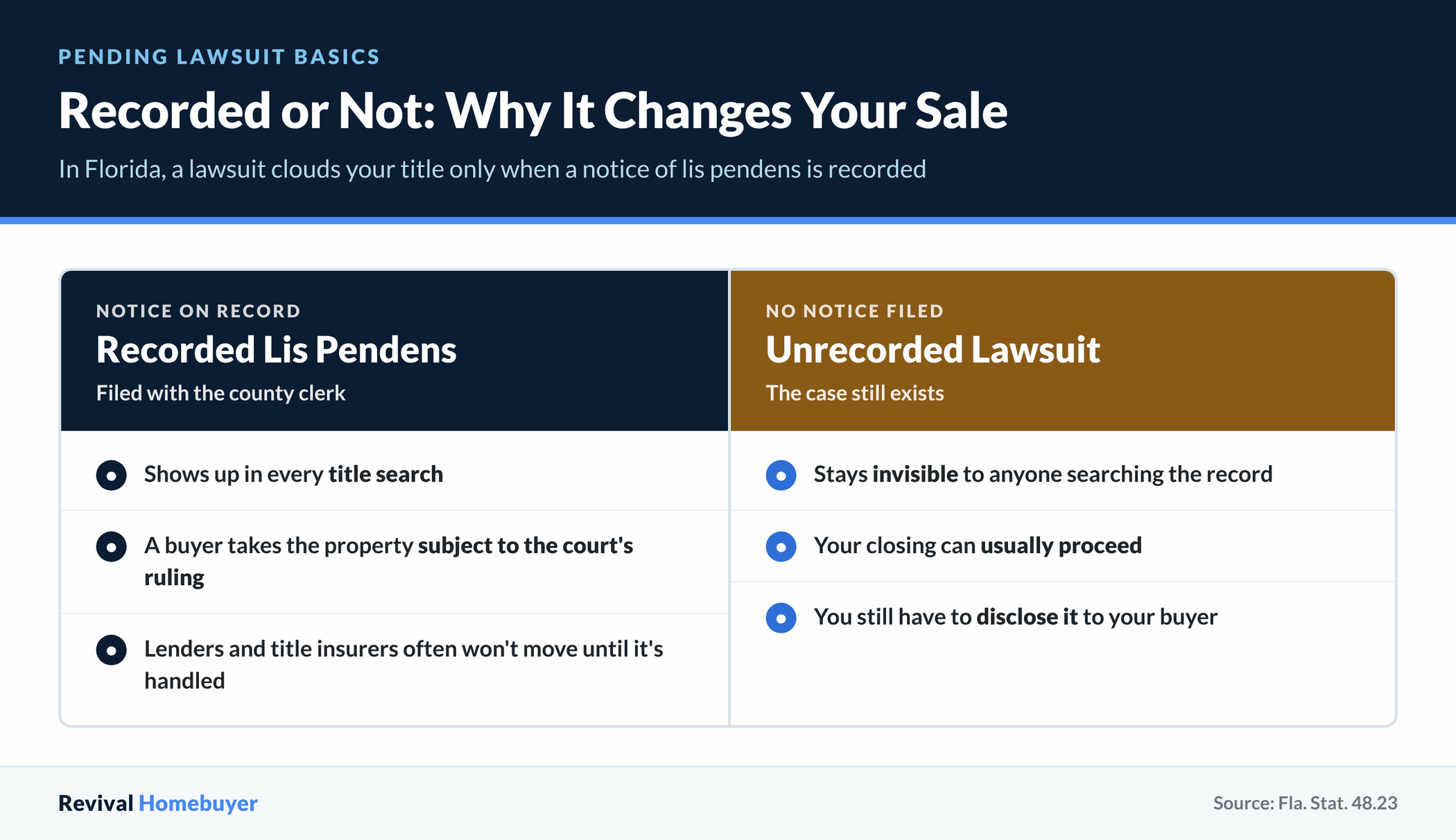
No. Usually it attaches a public warning label to your title. In this state, a lawsuit touching real estate clouds your title to outsiders only if the plaintiff records a notice of lis pendens. It goes into the official records of the county where the property sits. Until it’s filed, the case stays invisible to anyone searching the record. The notice also has to stay alive, meaning it hasn’t expired, been withdrawn or been discharged. Those are the terms of the lis pendens statute the Florida Legislature publishes at leg.state.fl.us.
Two Florida owners can face lawsuits of similar size and end up in very different spots. One case has a recording and the other doesn’t. Any title examiner will find the recorded one.
Mortgage foreclosure is a lawsuit too, and ATTOM counts the recorded lis pendens as one of its filings. Its mid-year 2026 report found 27,494 Florida properties with a foreclosure filing in the first half of the year. The rate works out to about one in every 373 housing units, the highest of any state and up roughly 33 percent from a year earlier.
For a seller, a mortgage case and a contractor’s lien case look alike on a title search. Each shows up as a recorded notice, and a financed buyer won’t close until it’s cleared.
Can You Sell a House in Florida During a Pending Lawsuit?
Early in my career I assumed a recorded lis pendens killed the sale, so I’d tell sellers to call me back after court. It was a bad call, and it cost a few Florida homeowners months they didn’t have.
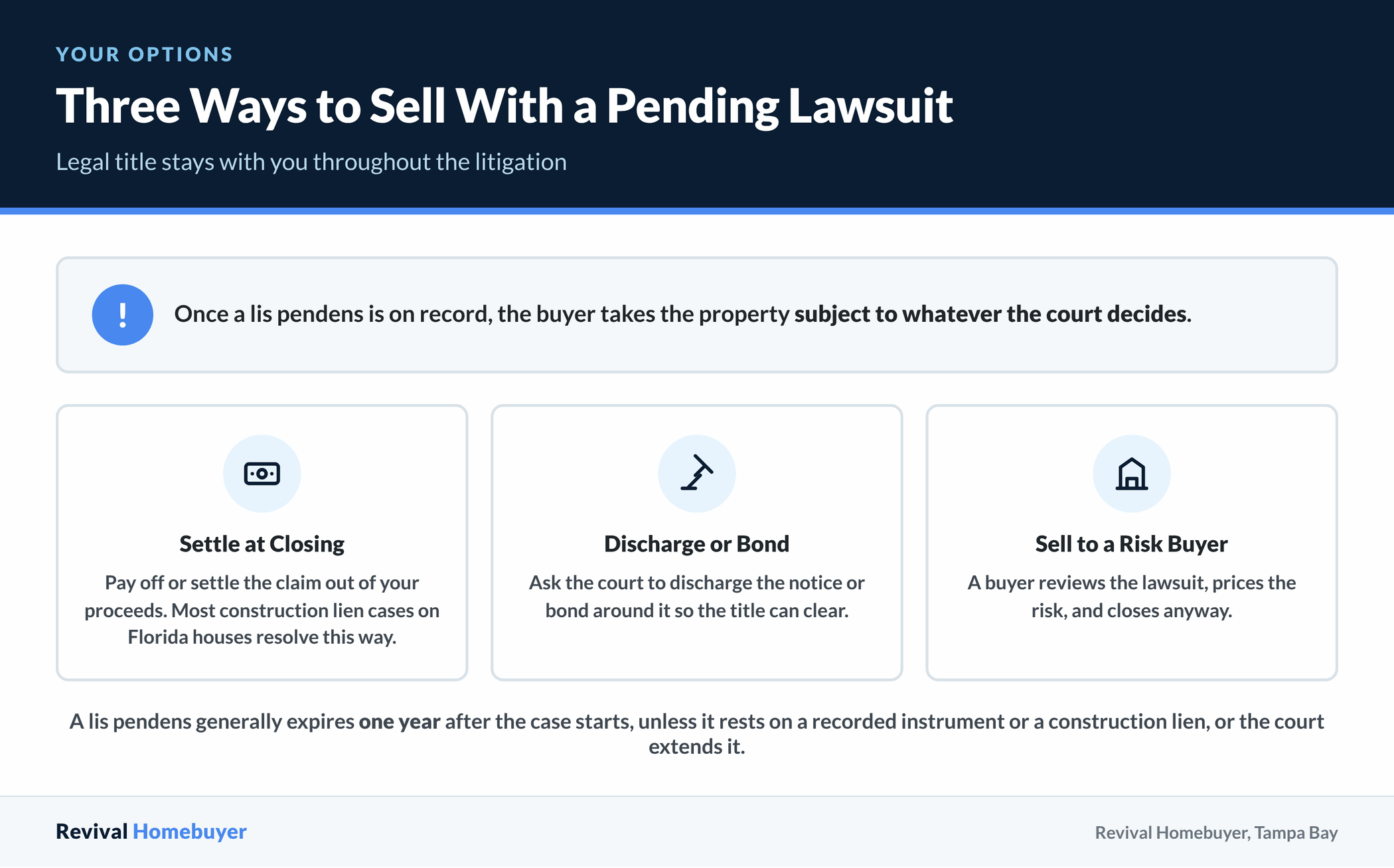
You can sell. Legal title stays with you while the case runs, and nothing in Florida law strips an owner of the right to convey just because a case is pending. What the buyer takes is another story. The statute says a suit for specific performance, or one not founded on a duly recorded instrument, has no effect on title or liens except between the parties. Recording a lis pendens that stays active is the one exception. Flip it around and the rule gets sharp. Once the notice is on record, a buyer takes the property subject to whatever the court decides.
Buyers who need a mortgage usually hit a wall here. Their lender won’t fund while the title underwriter refuses to insure over an open claim. Before long, their agent is steering them toward another house in Florida.
Three paths generally work, and I’ve watched each one play out on a property I looked at. A payoff or settlement of the claim at closing, out of your proceeds, is the first. Most construction lien cases I’ve seen on Florida houses ended that way. You can also ask the court to discharge the notice or bond around it. Or you sell to a buyer who reads the lawsuit and prices the risk before closing anyway.
If you plan to wait out the litigation, know one timing rule. A notice of lis pendens stops being effective one year after the action began. The clock doesn’t run when the claim rests on a duly recorded instrument or on a construction lien under part I of chapter 713. Judges can also extend it for good cause. Mortgage foreclosures ride on a recorded mortgage, so the one-year clock won’t help you there.
What Disclosures Are Required for a Pending Lawsuit Sale in Florida?
Florida has no state-mandated seller disclosure form.
The duty comes from case law instead of a checkbox. In Johnson v. Davis, decided in 1985, the Florida Supreme Court held that a home seller must disclose known facts that materially affect value. It reaches facts that aren’t readily observable and aren’t known to the buyer. An as-is clause doesn’t erase the duty, which surprises plenty of local owners who thought it worked as a shield.
Does a lawsuit against the house materially affect value? In almost every case I’ve seen, yes. Partition actions change what buyers will pay. So does a code enforcement suit from a Florida city or an unresolved claim over a seawall.
Tell them in writing.
A buyer’s attorney will pull the file anyway. I’d rather a Florida seller hand over the pending lawsuit details on day one. The alternative is a buyer finding them during the inspection period and walking away angry.
Real estate licensees carry their own obligation. Florida Statute 475.278 requires them to disclose all known material facts that aren’t readily observable to the buyer. One Florida Bar Journal article on buyer claims notes those duties can’t be disclaimed by contract. If you list with an agent, they have to speak up about the pending lawsuit whatever you’d prefer.
How Does a Pending Lawsuit Affect Buyers and Closing Timelines?
“Won’t a cash buyer just close next week and skip all this?” Not usually. Anyone in Florida who promises that without reading your court file is guessing. Someone still has to issue a title commitment, and the underwriter decides how to treat the pending lawsuit.
Market speed matters here too. Statewide, the median single-family price sat at $420,000 in October 2026, with inventory at a 4.6-month supply, according to Florida Realtors. Homes sold that month took a median of 47 days to go under contract and 87 days to close. Any seller facing a hearing date ninety days out has almost no runway on the open market.
Timelines stretch in predictable places. Title review runs longer because someone has to read pleadings instead of scanning for liens. When a Florida judge needs to sign off on a discharge, you wait for a hearing slot.
Cash buyers who work Florida litigation files regularly can move faster, since they absorb risk a lender won’t. That’s the whole trade. You accept a price that reflects the pending lawsuit. In return, the buyer accepts an outcome nobody can guarantee.
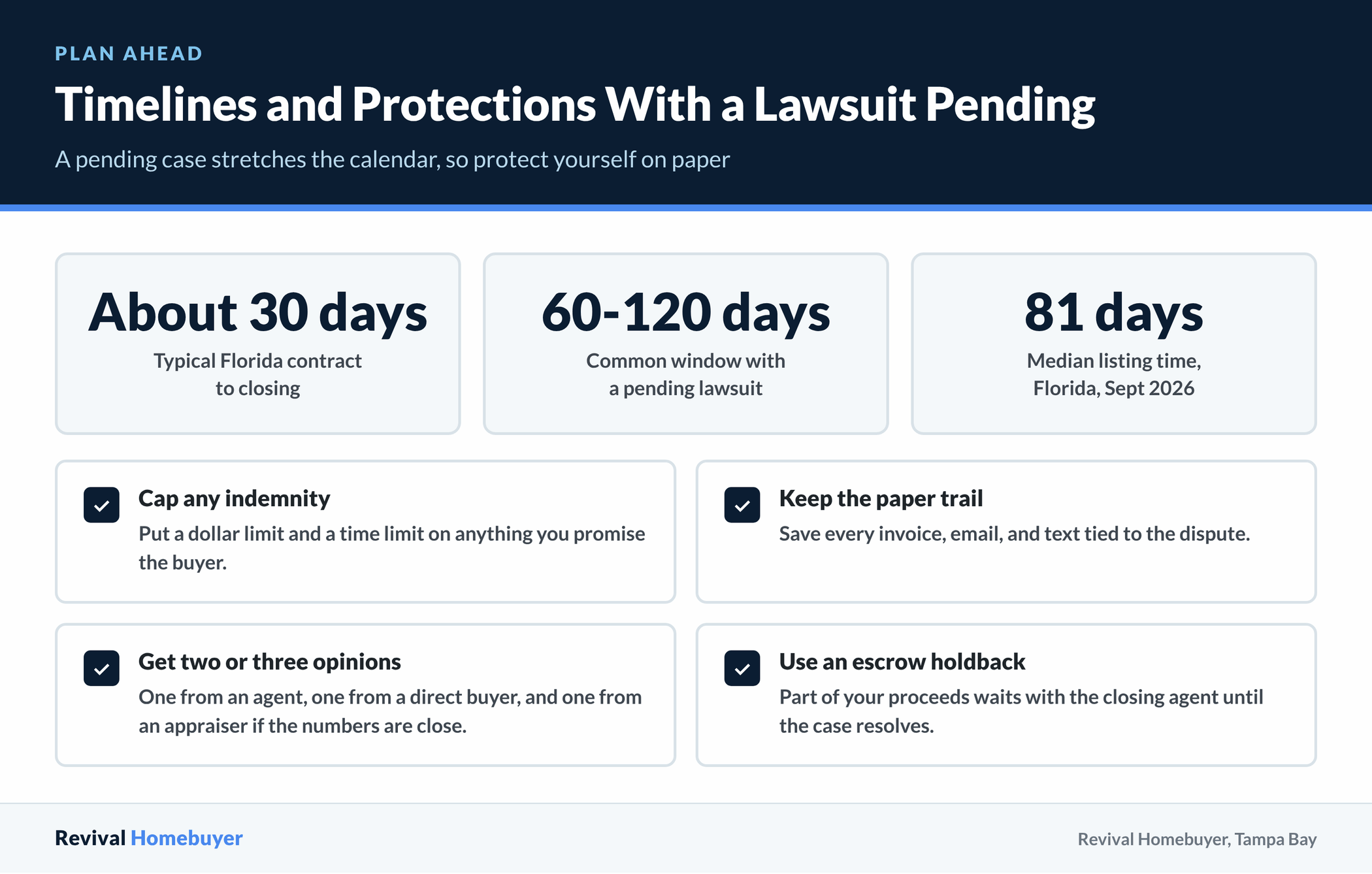
Escrow holdbacks rescue more of these sales than anything else I’ve seen. Part of your proceeds sits with the closing agent until the pending lawsuit resolves. The Florida buyer gets comfort that the claim won’t follow them.
Steps to Sell Your Florida House with a Pending Lawsuit
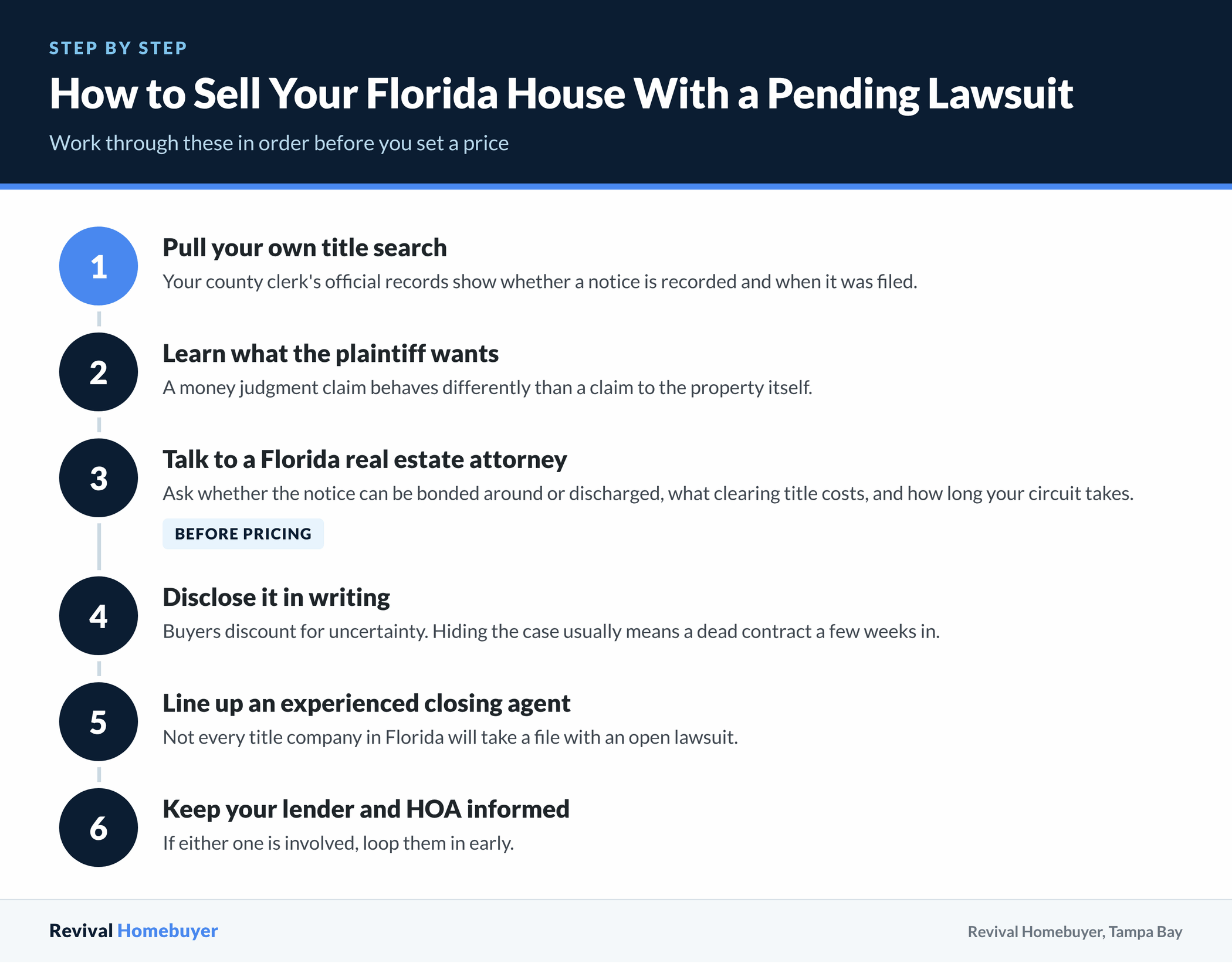
Pull your own title search before you talk to a single buyer. County clerk records show whether a notice is recorded against the property and when it was filed. Plenty of Florida owners find there’s no recording at all, meaning the case never touched their title in the first place.
Read what the plaintiff is asking for, since that drives everything downstream. Money judgment claims behave differently from claims to the property itself.
Talk to a Florida real estate attorney before you set a price. An hour of advice on whether the pending lawsuit can be bonded around or discharged beats a month of online reading. It’s worth the fee for that clarity alone. Ask what it costs to clear title and how long your judicial circuit takes to schedule a hearing.
Buyers in Florida discount for uncertainty. Pretending the litigation doesn’t exist just means a dead sale in week three.
Line up a closing agent who’s handled a pending lawsuit before. Not every title company in the state takes these files, and finding that out after you’ve signed a contract hurts. We keep a short list of Florida closing attorneys who don’t blink at a complicated file, and I’m glad to share it. Revival Homebuyer has worked with most of them across the Tampa Bay area.
Finally, keep your lender and your HOA in the loop if either one is involved. A payoff letter gives you the exact mortgage balance, and an HOA can tell you what it says you owe before closing day.
How to Protect Your Interests When a Lawsuit Is Pending Against Your Property
An owner in Sarasota came to me with a contractor’s claim recorded against her house. Her listing had sat for four months without a single offer. Six weeks later she closed, with the claim paid out of escrow at the table and the rest of the money hers.
Save every invoice and message tied to the dispute. Keep the dates straight too, because the order of who did what and when is often what a case like this turns on. Florida courts care about the paper trail, and so does any buyer sizing up your pending lawsuit.
Don’t sign a sale contract that makes you personally responsible for something you can’t control. I’ve seen Florida contracts where a seller agreed to cover the buyer for “all claims arising from the litigation.” It had no cap and no end date.
Cap it. Any indemnity you sign needs a dollar limit and a time limit.
Your equity changes the whole picture. Home values swing widely between Florida counties, so look at recent sales near you rather than a statewide number. With a lot of equity, you can settle the lawsuit and still walk away with a solid check. With thin equity, that same claim could eat all of it.
So what would your house really sell for today, once you’ve disclosed the lawsuit? Most Florida sellers I talk to are going off an online estimate they looked up last year. That was before anyone pulled the court file or figured out what the claim might cost.
Get two or three real opinions. An agent and a direct cash buyer will each give you a number. If those two land close together, an appraiser is worth adding. Then make your call.
Frequently Asked Questions About Selling a Florida Property With a Pending Lawsuit
Does a Pending Lawsuit Have to Be Recorded to Affect My Florida Sale?
Only a recorded notice clouds your title, as covered above. An unrecorded case still exists and can still produce a judgment. No title search will flag it, though, and your closing can usually go ahead. Your disclosure duty doesn’t depend on what the clerk has on file, so tell your buyer either way.
Can I Sell My Florida House Before the Lawsuit Is Resolved?
You can, and plenty of Florida owners do. Settlement at the closing table is the resolution I see most, with your proceeds paying the claim and the plaintiff releasing it. The other route is a buyer willing to take the property with the case still open. That almost always means a cash buyer and a price adjustment.
Will I Get Less for My House Because of a Pending Lawsuit?
Usually, though the gap shrinks when the claim is well documented and the amount is known. Buyers weigh uncertainty more heavily than dollars, so a clear, bounded claim costs you less than a vague one. Put the complaint and the ledger in front of a buyer early, along with your attorney’s read on the case. Nothing narrows that discount more cheaply.
Talk With Us About Your Court File
Every pending lawsuit looks a little different, and you don’t have to sort yours out alone. Reach out to Revival Homebuyer with the basics of your case. You can also fill out the short form below, and we’ll get back to you with honest options.