
Three weeks under contract, and then the lender pulls out. Your listing goes back to active, the neighbors notice, and you start over with less leverage than you had in week one. That pattern is why so many Florida sellers start asking about offers with no contingencies, where the buyer commits without an escape hatch bolted to every page of the contract.
What Does Selling with No Contingencies Mean in Florida?
If you take nothing else from this, take this: a contingency is a legal exit door. Every one you agree to is a door the buyer can walk through while you wait. A sale with no contingencies simply removes those doors. The buyer agrees to buy your property without conditioning the closing on an inspection outcome, a lender’s approval, or a home appraisal coming in at the number everyone hoped for.
One form handles most Florida sales. The FAR/BAR Residential Contract for Sale and Purchase, drafted jointly by Florida Realtors and the Florida Bar, carries more residential transactions in the state than any other document. Contingencies live inside that contract as named paragraphs with their own deadlines. Strip them out and the buyer’s obligation to close stands on its own.
Early last year I bought a small ranch house in North Port from a widow who was also unwinding a divorce from a second marriage. She wanted the whole thing handled before the holidays, not a parade of inspectors tracking sand through her Florida room on a Tuesday afternoon. So we wrote it that way and she stopped thinking about it after she signed.
Selling without them doesn’t mean selling blind, and it doesn’t mean you hide anything. Sellers in Florida still owe disclosure of known material defects that a buyer wouldn’t readily see. The buyer in such a sale typically does their homework before signing rather than after. It flips the order of operations, not the honesty of the transaction.
What’s the Difference Between Contingent and No Contingencies Sales?
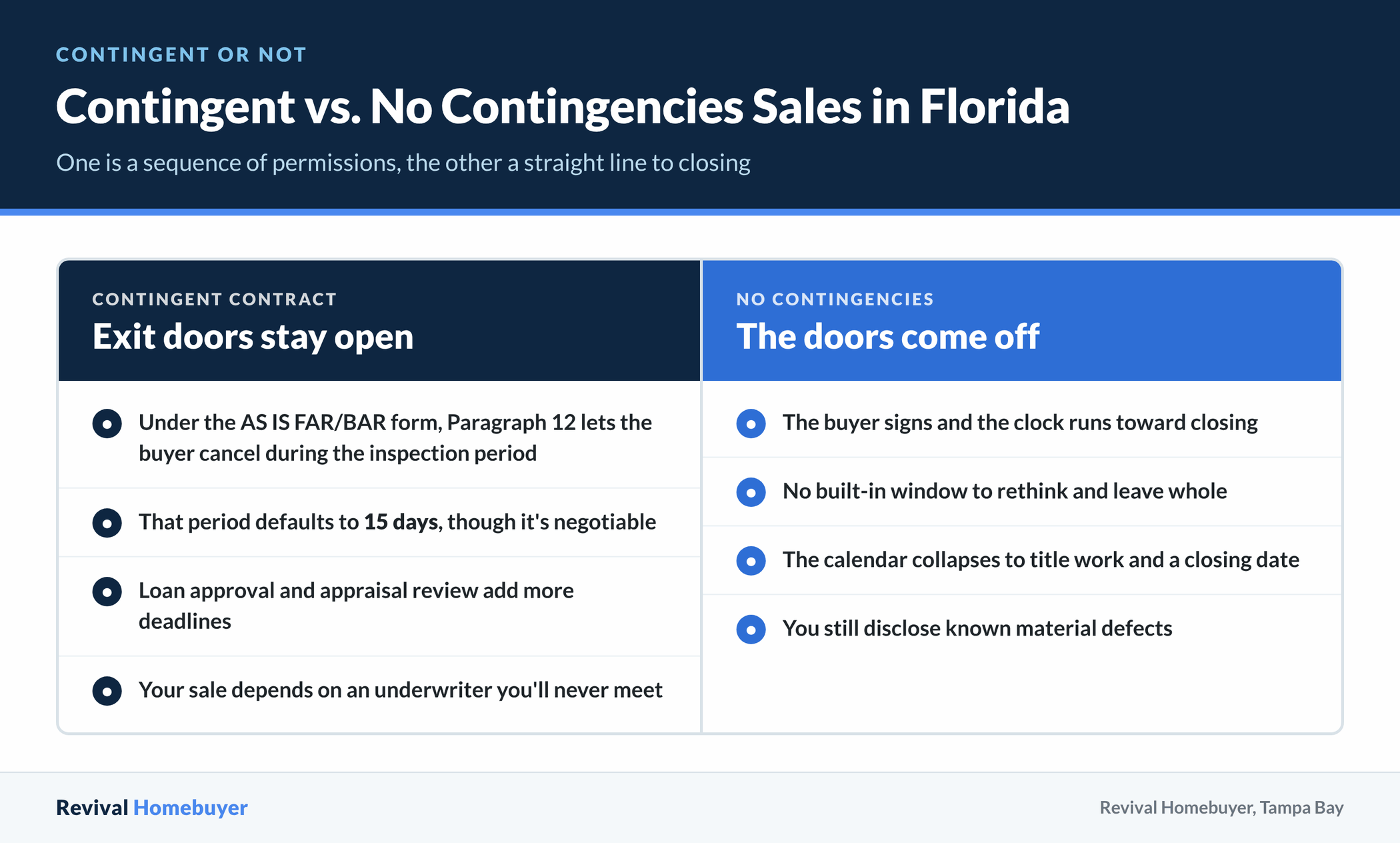
A contingent contract in Florida is closer to an option than a sale, and I think sellers deserve to hear that said plainly. Under the AS IS version of the FAR/BAR form, Paragraph 12 lets the buyer cancel during the inspection period at their sole discretion and take the deposit back with them. Any reason. No reason. That inspection period defaults to 15 days in the form, though it’s negotiable.
Compare that to waiving them all. The buyer signs, the clock runs toward closing, and there’s no built-in window where they can rethink the whole thing and leave whole.
Financing is the other big divide. A contingent buyer in Florida typically gets a defined stretch to secure a loan. If loan approval doesn’t come through despite genuine effort, the buyer can terminate and recover the escrow deposit. So a mortgage contingency means your sale depends on an underwriter you’ll never meet reviewing documents you’ll never see.
Which sale would you rather be sitting in during hurricane season, when insurance quotes can rattle a lender’s file at the last minute?
Timing separates the two as much as risk does, which means sellers feel the difference well before closing day. Contingent sales in Florida stack deadlines: deposit delivery, inspection expiration, loan approval, appraisal review, then closing. With none attached, the calendar collapses to title work and a closing date. One is a sequence of permissions; the other is a straight line to the closing table.
What Contingencies Do Florida Buyers Usually Ask For?
Once, a Pinellas Park seller called me after her third contract died, this one over a four-point insurance inspection on a 1978 roof. Each buyer had asked for the same handful of protections, and each one used a different one to leave.
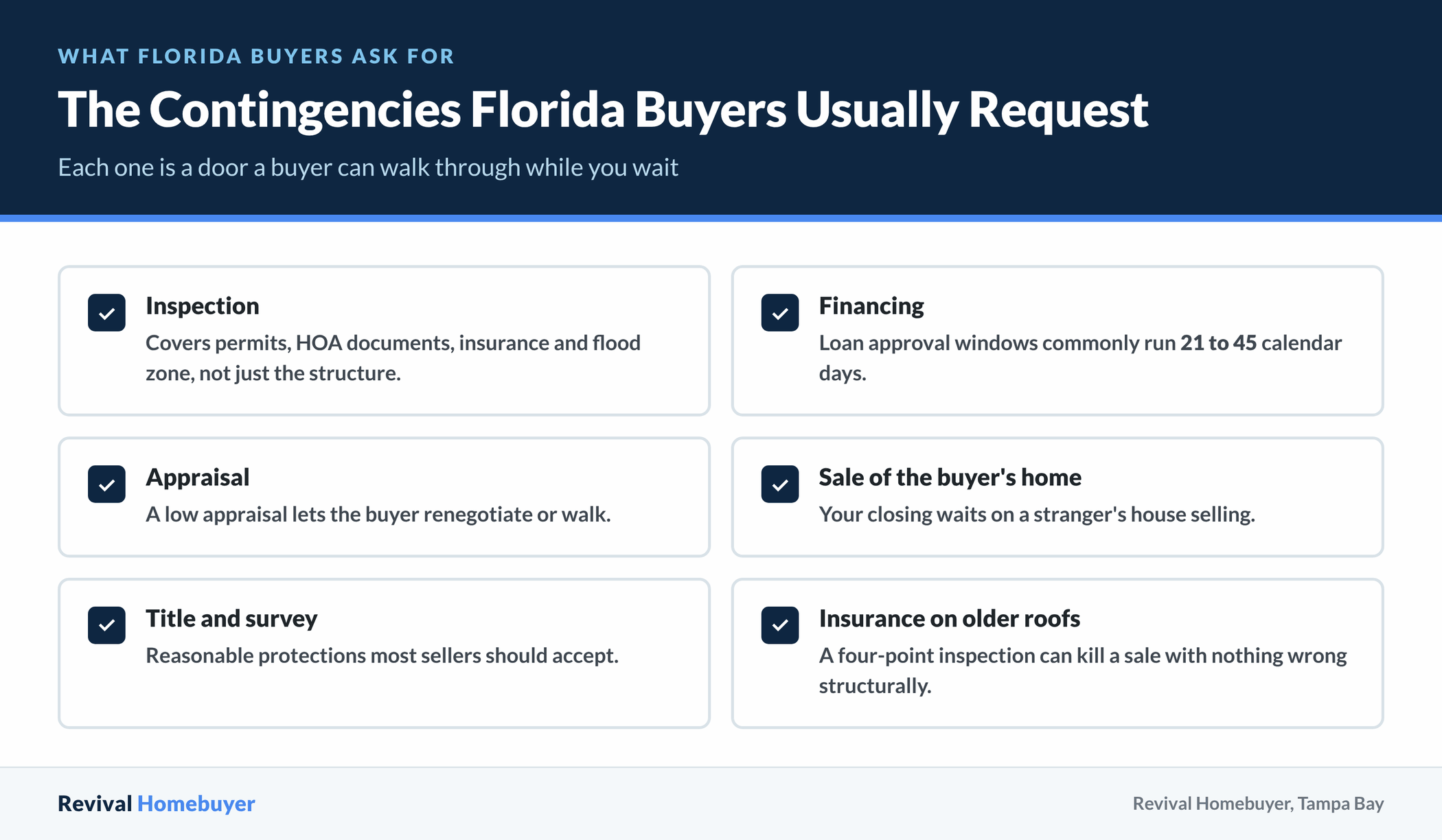
Inspection sits at the top of the list and does the most damage to sellers. Buyers use that window to look at far more than the physical house. Permits, HOA documents, insurance availability and pricing, and flood zone designation all get investigated inside it. In coastal Florida, the insurance piece alone kills sales that had nothing wrong with the structure.
Financing contingencies come next and tend to run longer than sellers picture. Loan approval windows commonly land somewhere between 21 and 45 calendar days in Florida contracts.
Appraisal contingencies tie your price to a third party’s opinion. If the property appraisals land under contract price, the buyer can renegotiate or walk. In softening pockets of the Florida market that gap shows up more than it used to. Sale-of-home contingencies are the worst of the bunch, because your closing now waits on a stranger’s house in another county selling to someone you’ll never speak with.
Title and survey conditions also appear, though those are reasonable and most sellers should accept them. After years of buying houses, here’s my take: an experienced buyer asking for clean title protection is being professional. A buyer asking for inspection, financing, appraisal, and a home sale contingency all at once is the opposite of a no contingencies offer. Such a buyer is asking you to hold your property off the market for free.
Why Do Florida Sellers Prefer No Contingencies Sales?
Sellers picture the highest offer as the best offer, and on paper that math holds. Then the appraisal comes in low and the buyer requests $14,000 in roof credits. Suddenly the winning number quietly turns into the second-best number with six weeks burned off the calendar. I’ve watched this play out enough times that a slightly lower offer with none attached frequently nets more than the headline offer that erodes at every checkpoint.
The Florida market right now rewards certainty. Statewide, single-family homes took a median of 87 days to go from listing to closing in September 2026, and price cuts were common. Carrying costs don’t pause during those months: insurance, taxes, lawn service, electricity to keep humidity out of the drywall.
Showings wear people down, too. Keeping a house spotless for strangers through a Florida summer is its own job.
Cash and condition-flexible buyers hold a real share of this market. Florida Realtors reported that 26.9% of single-family closings in August 2026 were cash sales, which comes out to roughly 5,782 transactions. Those buyers are the ones most able to write without them, since they aren’t answering to a lender’s conditions.
Sellers in probate, divorce, relocation, or inherited-property situations tell me the same thing in different words: they want the decision to be final when they make it. They don’t have to wonder if the ground will shift under them later. Contracts without conditions give them that. My team at Revival Homebuyer structures Florida sales this way routinely. It’s why distressed and time-sensitive sellers often end up talking to a direct buyer instead of relisting for a fourth time.
How Does a No Contingencies Sale Protect Your Deposit?
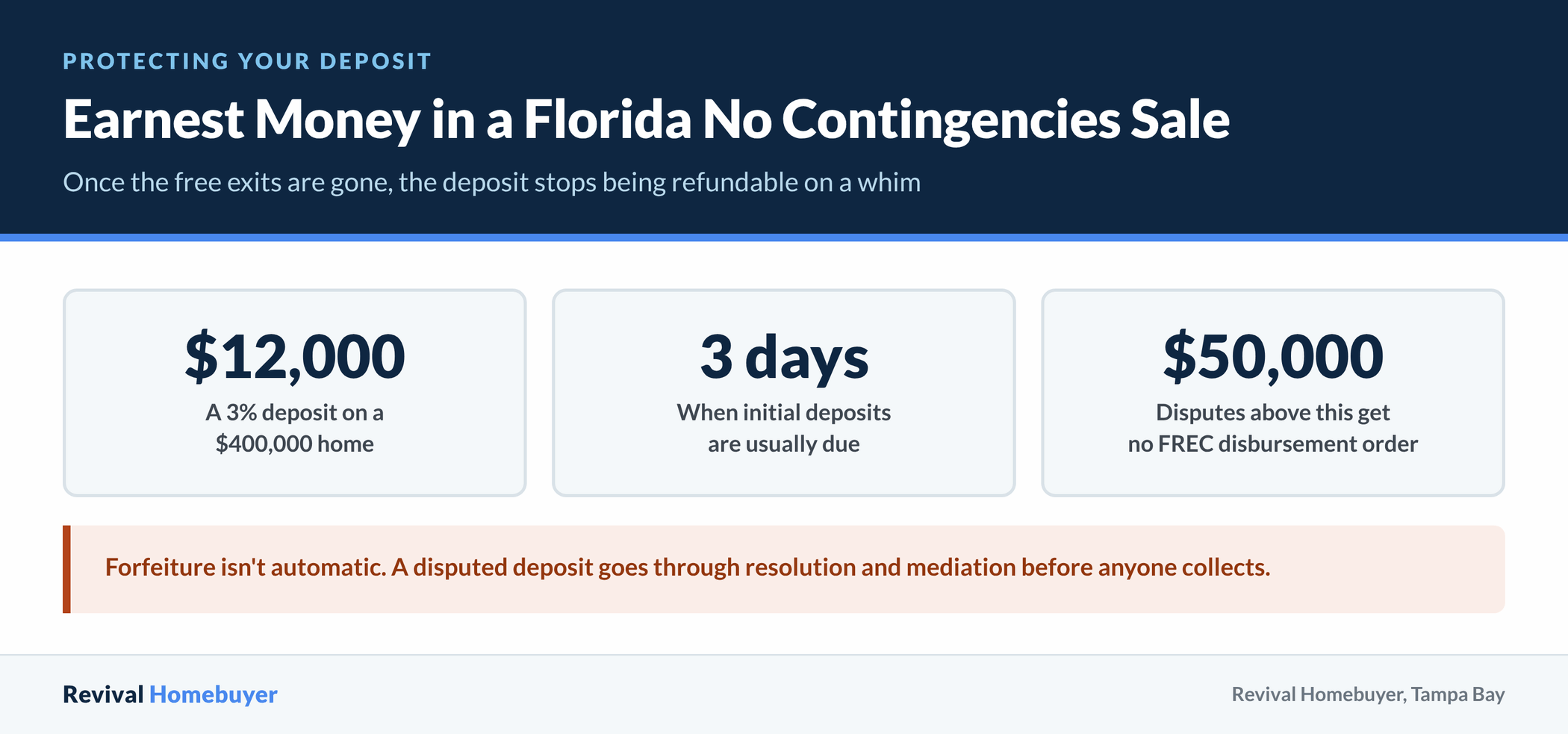
On a $400,000 Florida home, a 3% earnest money deposit is $12,000, and whether you keep it depends entirely on which contingencies survived negotiation. Initial deposits are usually due within three days of the effective date and run a small fraction of the price. Additional deposits sometimes push the total toward 5% to 10%.
With no contingencies in the contract, that earnest money stops being refundable on the buyer’s whim. Once the inspection period expires, a buyer who cancels generally forfeits the deposit to the seller, with limited exceptions. Remove the inspection period and you’ve already removed the main free exit from day one.
Forfeiture isn’t automatic, and any Florida seller should understand that before celebrating. An escrow agent can’t just hand over a disputed deposit. The FAR/BAR contract calls for a short window to resolve it between the parties, then mediation, with litigation or a mutual release after that. Florida brokers holding escrow face their own rules. The Florida Real Estate Commission won’t issue an escrow disbursement order when the disputed amount exceeds $50,000, per Florida Realtors’ escrow guidance.
Pay as much attention to where the money sits as to the contract language. The escrow agent named in a Florida contract is usually the title company or closing attorney, and occasionally a broker. I push sellers toward a title company or real estate attorney as escrow agent on larger deposits, simply because the disbursement path is cleaner.
Would a bigger deposit change how seriously you took a buyer? It changes how seriously I take one.
Can a No Contingencies Sale Still Fall Through in Florida?
Which brings up the uncomfortable part, because yes, it can. No contingencies removes the buyer’s convenient exits; it doesn’t remove reality. Title defects surface. An unpermitted Florida lanai addition from 1994 shows up in the county records and has to be resolved before a deed can transfer cleanly.
Probate issues stall closings regularly. A missing heir signature or an open estate in a Florida county court will hold a sale no matter how airtight your contract reads.
Buyers who simply refuse to close are the rarer problem, and that’s breach, not cancellation. A buyer who sends written termination notice before the inspection period expires hasn’t breached the contract. Someone with no contingencies and no notice period has nothing comparable to lean on. Your remedies then involve the deposit and, depending on the contract, other claims your attorney would walk you through.
Lender surprises can still intrude when a buyer plans to finance despite waiving the protection. Waiving a financing contingency doesn’t manufacture a loan. The buyer is simply on the hook if the money doesn’t arrive. This is exactly why I treat a financed offer with no contingencies more cautiously than a verified cash offer at the same price.
Insurance is the Florida wildcard nobody can draft around. Older roofs in Largo, Brooksville, and parts of Hillsborough County can price a buyer out between contract and closing.
Ask any buyer offering no contingencies for proof of funds, and ask the escrow agent to confirm the deposit landed. Two phone calls. They’ve saved sellers I work with more aggravation than any clause ever has.
How Fast Can You Close a House with No Contingencies in Florida?
Guess wrong on your closing date and you end up paying for two roofs over your head, or you’re out of your Florida house with nowhere to land. Timing is the thing sellers underestimate most.
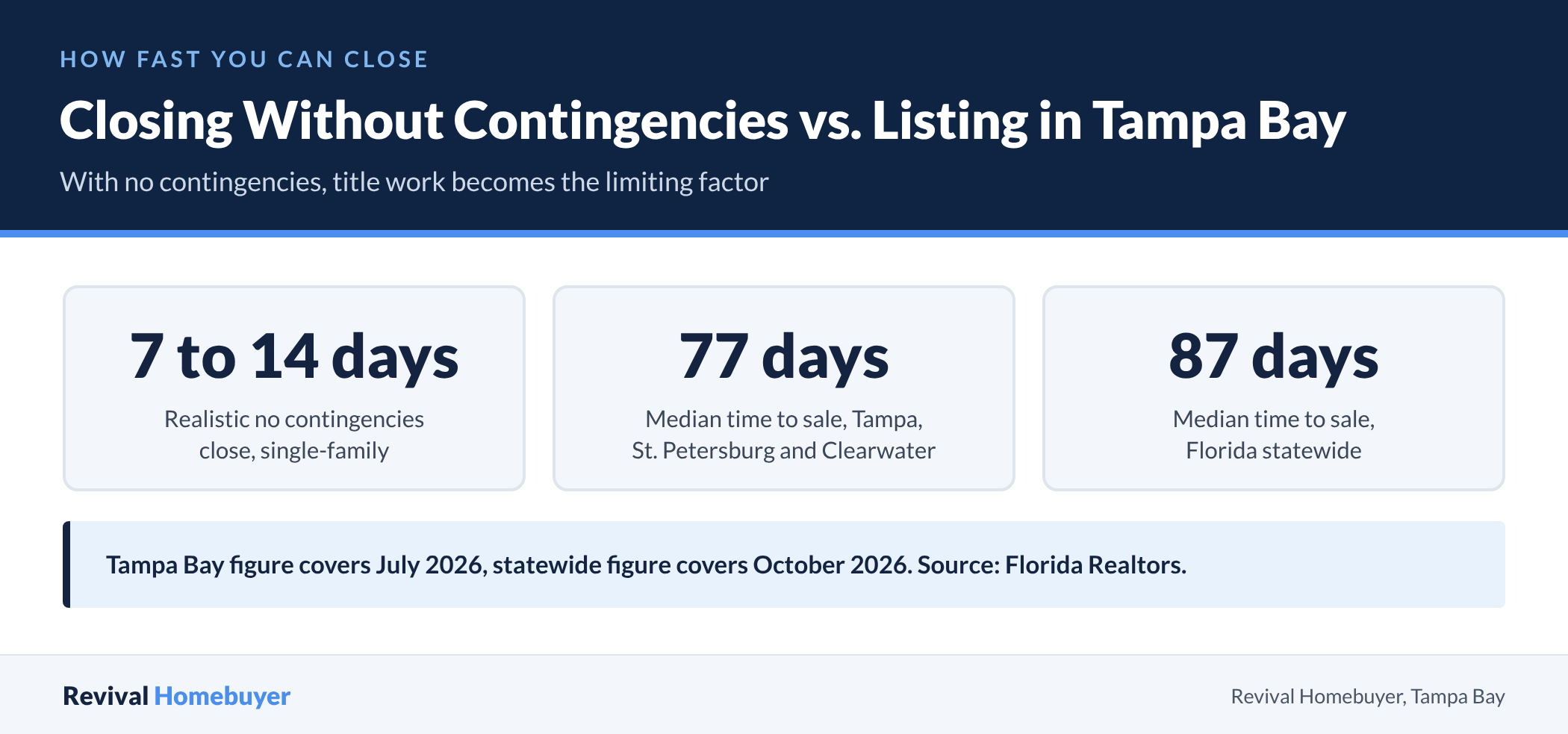
Strip the contingencies away and the limiting factor becomes title. A clean title search, lien payoffs, a municipal lien search, estoppel letters for condos and HOAs, and the deed preparation all have to line up. Seven to fourteen days is realistic on an uncomplicated single-family property. Condos run longer because estoppel letters from Florida associations arrive when they arrive.
Compare that against the listed route. In the Tampa, St. Petersburg and Clearwater metro, single-family homes that sold in July 2026 took a median of 77 days from listing to closing, according to the Pinellas Realtor Organization’s metro market report. That’s months on the calendar, not weeks.
Prices themselves have flattened across much of Florida, which raises the value of speed. The statewide median single-family price was $420,000 at the end of October 2026, up 2.2% year over year, with inventory at a 4.6 month supply. Slow appreciation means waiting rarely pays for itself.
One mistake I see constantly: sellers agree to a 10-day closing because it sounds impressive, then realize they haven’t arranged movers, a storage unit, or anywhere to sleep. Build in the days you need. A buyer writing with no contingencies can almost always flex the closing date, since the certainty they wanted is in the terms, not the calendar.
Should You Sell to a Cash Buyer for a No Contingencies Sale?
Is a cash offer actually worth less once everything is factored in? “A cash buyer is just going to lowball me.” Fair concern, and sometimes true. The honest comparison isn’t offer price against offer price. It’s net proceeds against net proceeds, with commissions, concessions, repairs, and three more months of Florida insurance premiums factored into the listed-sale column.
Cash buyers can write with no contingencies because nothing external has to approve them. Florida Realtors data shows cash buyers making up between a quarter and a third of single-family closings in recent months. In some Florida submarkets the share runs higher still.
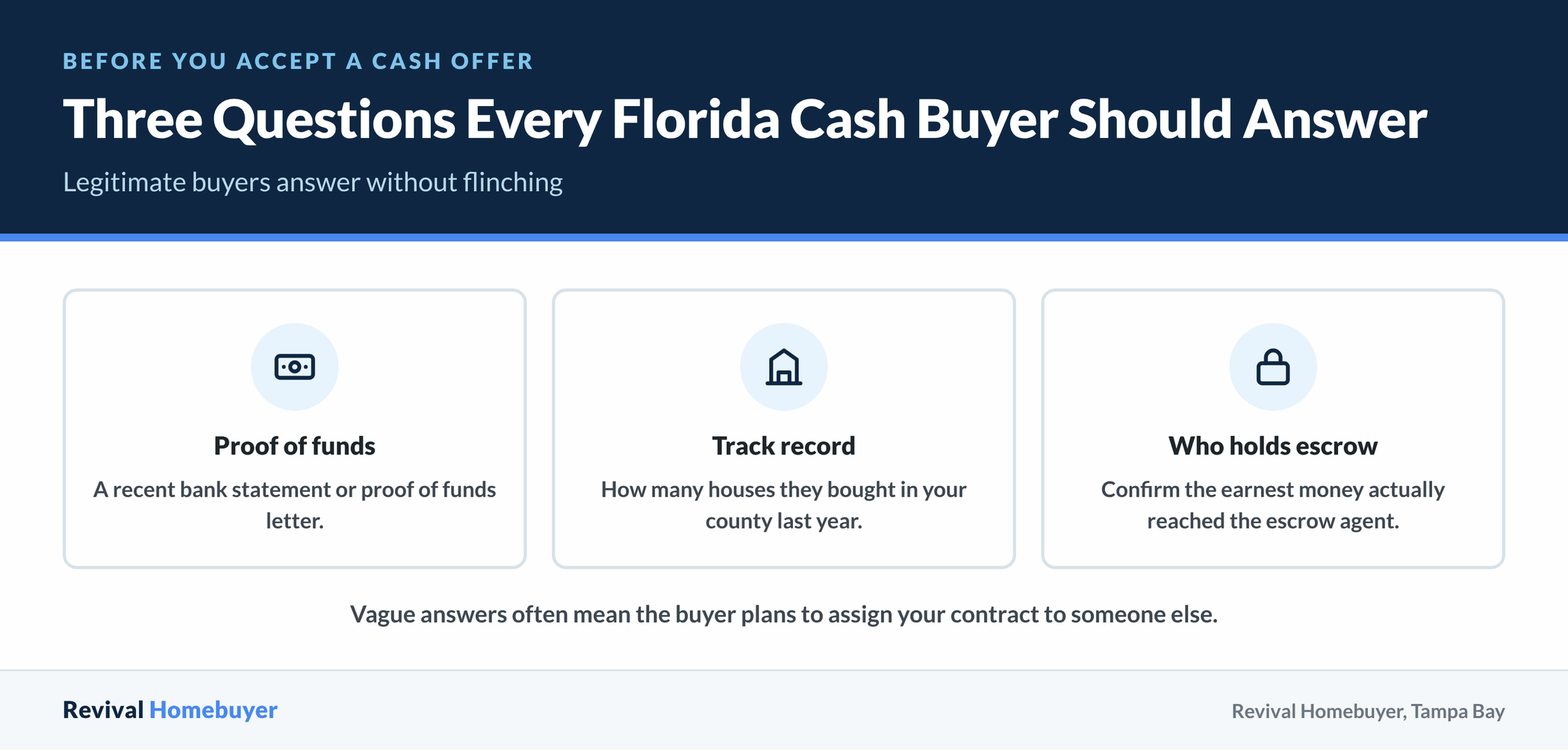
Not every cash buyer deserves your trust. Some tie up Florida properties and shop the contract to someone else, then renegotiate when they can’t find a taker. Request proof of funds, ask how many houses they bought in your county last year, and ask who holds escrow. A legitimate operation like Revival Homebuyer answers all three without flinching.
One Spring Hill owner reached out after carrying two mortgages for close to a year. He had moved north for a job while his Florida house sat empty, with a boat trailer still parked in the garage. He’d listed twice, had two contingent buyers cancel during inspection, and was out thousands in payments on a house nobody lived in. We closed with no contingencies about three weeks after his first call.
Should you sell this way? Say your Florida property is in good shape, you aren’t in a hurry, and you can absorb a few months of uncertainty. Then listing on the open market may well beat a no contingencies offer on price. If any one of those three isn’t true, the certainty tends to be worth more than the spread.
Frequently Asked Questions About No Contingencies Sales in Florida
What Does It Actually Mean to Sell a House with No Contingencies?
Selling with no contingencies means the buyer’s duty to close isn’t conditioned on an inspection result, a loan approval, an appraisal figure, or the sale of another property. In Florida the buyer still gets title work done and you still disclose known material defects. What the buyer has removed are the contract paragraphs that would let them cancel and recover their earnest money. You’re trading some negotiating room on price for a contract that doesn’t unravel midstream.
Can a Buyer Back Out of a Non-contingent Offer in Florida?
A buyer can always physically walk away. Walking away from a Florida contract with no contingencies usually means losing the deposit and facing whatever other remedies the contract grants you. Since the escrow agent can’t release disputed funds on its own, you’d follow the resolution and mediation path the FAR/BAR form lays out before anything gets decided. Most buyers who write without contingencies have already done their diligence and intend to close.
Do I Still Need a Real Estate Attorney for a No Contingencies Sale in Florida?
Florida doesn’t require an attorney at closing, and plenty of transactions run through a title company alone. That said, I recommend counsel any time the title is cloudy, the property came through probate, there are multiple owners who disagree, or the deposit is large. An hour of a Florida real estate lawyer’s time costs far less than a stalled closing.
Will I Get Less Money Selling with No Contingencies?
Sometimes, and the comparison deserves real arithmetic rather than a gut reaction. Subtract agent commissions, buyer concessions, repair credits, and the carrying costs of several more months of ownership from a traditional Florida listing. Then set that figure beside a direct offer with no contingencies. Sellers are often surprised how close the two columns land, especially on older homes with insurance or roof issues.
Can I Sell a Florida House with No Contingencies If It Has a Mortgage or Liens?
Yes. The payoff happens at closing out of the sale proceeds, exactly as it would in any other Florida transaction. Liens, code enforcement claims, and unpaid HOA assessments all surface during the title search and get resolved before the deed records. That’s one reason even a no contingencies closing needs a competent title company handling the file.
How Do I Know a No Contingencies Offer Is Legitimate?
Verify the money and verify the track record. Ask for a recent bank statement or proof of funds letter, and confirm the earnest money reached the escrow agent. Then look up whether the buyer has actually recorded deeds in your Florida county. Buyers who intend to close have no problem with any of that; buyers who plan to assign your contract to someone else tend to get vague.
Tampa Homeowners and No Contingencies Offers
Single-family homes across the Tampa, St. Petersburg and Clearwater metro sold for a median of $415,000 in July 2026, according to Florida Realtors data. At that price, a few extra months of insurance, taxes and showings add up quickly. If you have questions before you decide, check out other frequent questions sellers ask us.
Talk Through a No Contingencies Offer on Your Florida Home
Maybe you’re weighing a traditional listing against a no contingencies sale and want to run the actual numbers on your Florida property. I’m happy to talk it through with you. Ask whatever you want, take the information, and decide on your own timeline. No pressure, no obligation, and no hard feelings if listing turns out to be the better move for your situation.
Curious how a cash offer stacks up next to a listing? Contact Revival Homebuyer and tell us about your property. You can also fill out the form below. There’s no obligation, and if listing makes more sense, we’ll say so.