
A seller once told me her new employer gave her a start date six weeks out. The house had a leaking roof, a basement full of her late father’s tools and a mortgage that didn’t care about anybody’s new commute. That’s the squeeze almost every long-distance seller lands in: two clocks running at different speeds, and only one of them is yours to set. If you have to sell house and move out of state on a timeline you didn’t choose, the stress rarely comes from the paperwork. It comes from not knowing which decision to make first.
Who Needs to Sell a House and Move Out of State?
A mother spends forty years in the same ranch house, then follows the grandkids south. Hers is one of a few familiar stories behind searches for how to sell house and move out of state.
Military orders and job transfers come with fixed dates. Divorce can require splitting the equity before anything else moves forward. Landlords get tired of managing a property from a different time zone and finally admit it.
You can’t delay a transfer date.
Years back I worked with two adult children, both living out of state, whose mother in Lakeland had moved into assisted living. They’d listed the place with two different agents. Both listings ran out with no offers at all. Part of the reason was the back bedroom, where a window AC unit still sat propped on a stack of phone books, which told me nobody had touched the place in months. They wanted the keys out of their hands before hurricane season.
Inherited property drives a lot of these sales. So does job relocation, which is the single most common reason I hear. Health is the quiet one nobody plans for. A diagnosis, a fall or a parent who suddenly needs care in another state can turn the house into the obstacle standing between a family and the thing that matters.
Nobody needs a big reason, either. Wanting to be near your people is reason enough.
What Should You Do Before You Move Out of State?
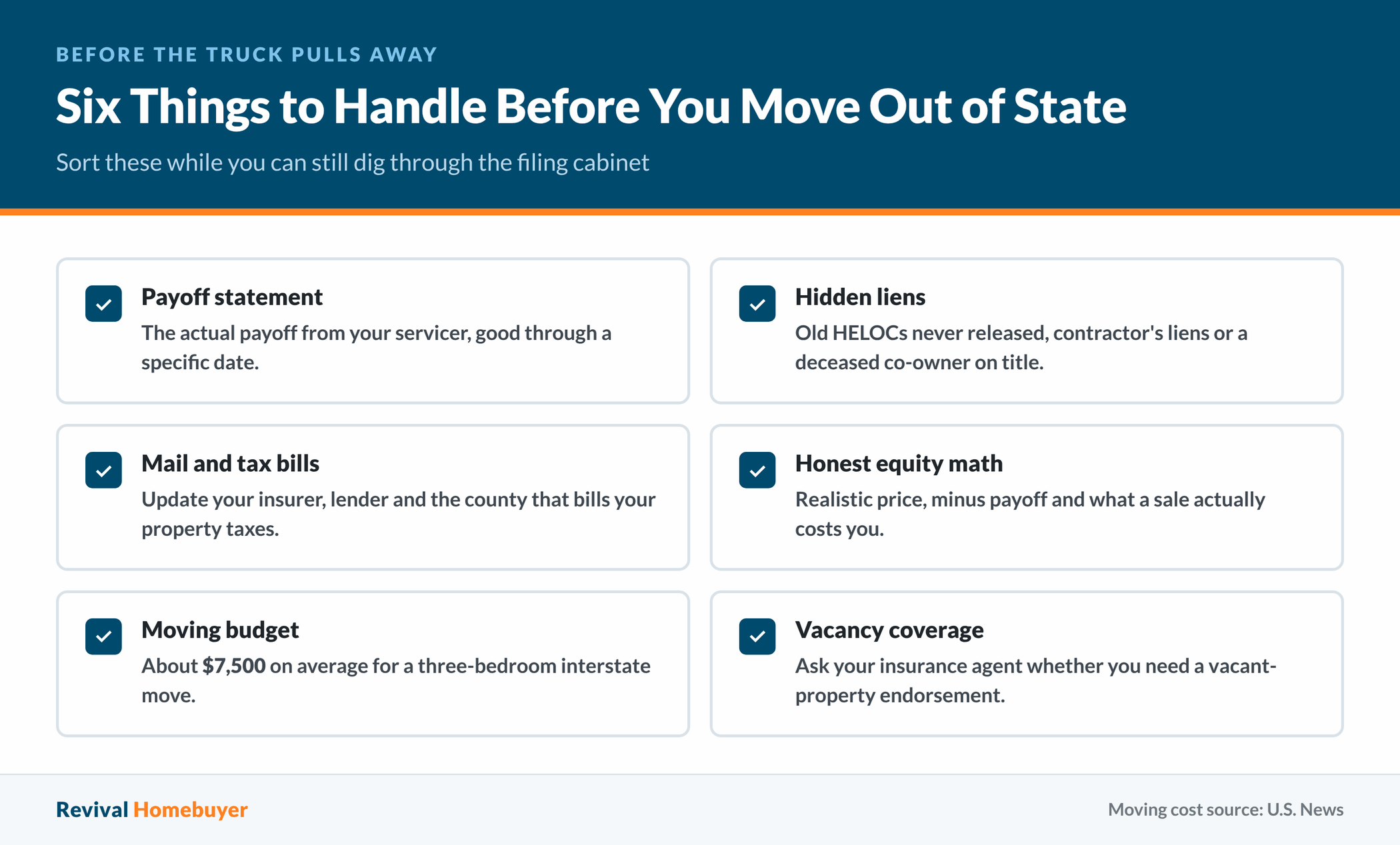
Around $7,500 is what a three-bedroom household pays on average for a long-distance interstate move, according to U.S. News moving cost research. Full-service packing pushes a 960-mile move toward $9,000 to $11,000. That number should shape your decisions, since it comes out of the same pocket as everything else.
Pull your mortgage payoff statement first. Not your balance from the app; the actual payoff, good through a specific date, from your servicer.
I keep seeing the same preventable delay: a lien nobody knew about. An old HELOC that was paid but never released. There’s the contractor’s lien from a roof job in 2019, or a deceased co-owner still on title. Any of those can stall a closing by weeks, and weeks are the one thing a relocating seller doesn’t have. Find them while you’re still in the house and can dig through the filing cabinet.
Set up mail forwarding and change your address with your insurer, your lender and the county that bills your property taxes. Tax bills go out on the county’s schedule, not yours. Miss one on a house you still own, and you’ve created a problem you’ll be solving by phone from somewhere else.
Figure out your equity honestly. Take a realistic price, then subtract your payoff and what a sale actually costs you. For traditional listings, agent commissions are the biggest single bite, and title fees, transfer taxes and buyer concessions pile on top. Transfer tax rules differ sharply from state to state, so don’t assume a number until you check with your county recorder or clerk.
What Are Your Options for Selling a House Before You Move Out of State?
Pick the wrong path here and you’ll be paying a mortgage, utilities, insurance and lawn care on an empty house in a state you no longer live in, for months. That’s the real cost of a bad decision, and it grows the longer the house sits.
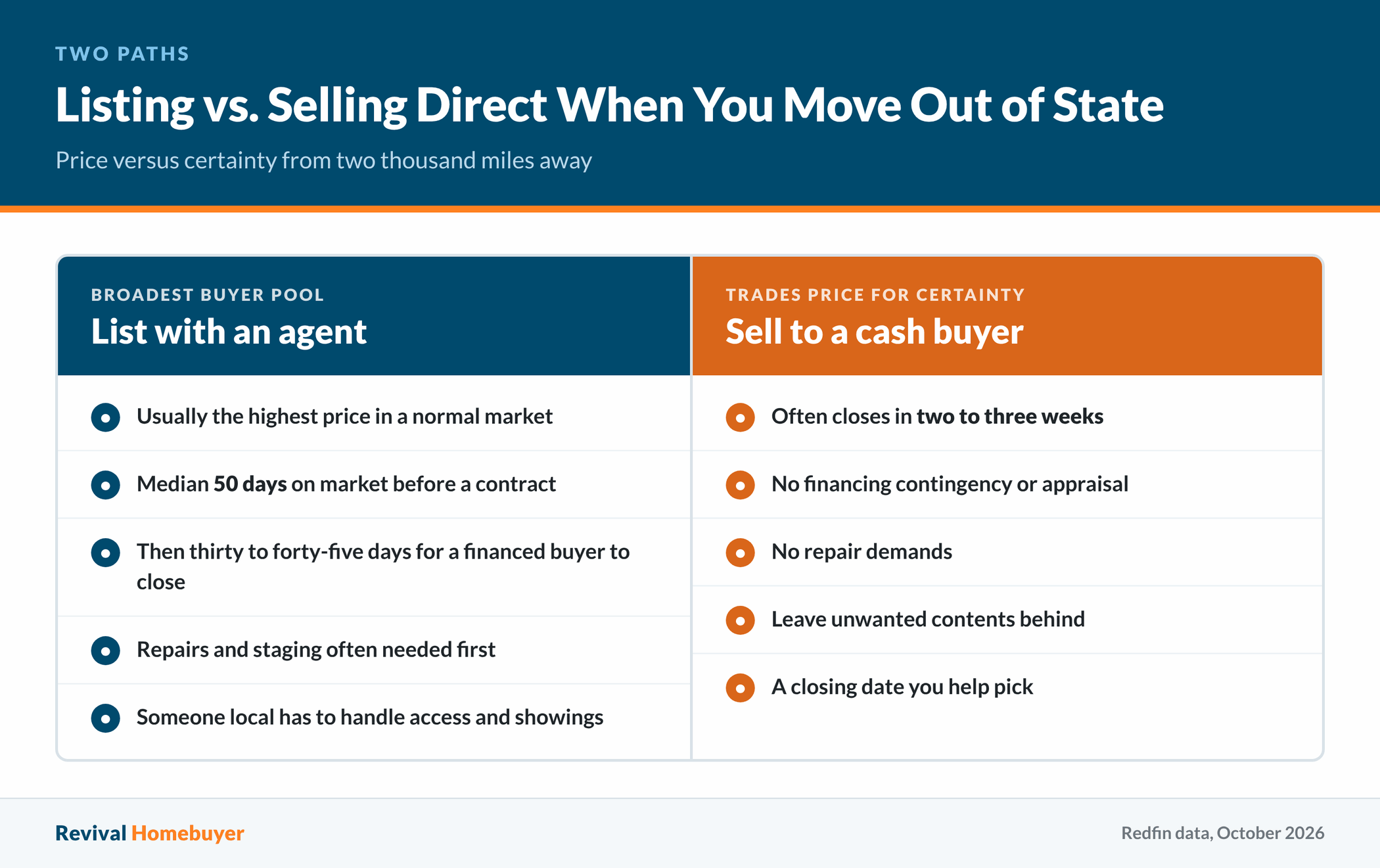
Sellers who look up how to sell house and move out of state usually end up weighing three paths. Listing with an agent gets you the broadest buyer pool, and in a normal market that pool produces the highest price. Nationally, the median home sale price was $388,634 in October 2026, down 0.4% from a year earlier. It was the first annual decline since May 2023, according to Redfin’s October 2026 report. Waiting on appreciation isn’t a listing strategy anymore.
Selling directly to a cash buyer trades price for certainty. You get a shorter timeline, no financing contingency, no repair demands and a closing date you help pick. Revival Homebuyer works this way with relocating sellers. The reason people choose it usually isn’t the offer amount; it’s that they can book a mover against a date that won’t slide.
Remote landlording sounds like a way to keep the asset and let a tenant pay the note. In practice you’re hiring a property manager who takes a cut, carrying vacancy risk and hearing about a 2 a.m. water heater failure through a stranger’s phone call. You’re also converting a tax-advantaged primary residence into a rental with different rules attached.
What would it cost you to carry this house for four extra months? Multiply your monthly payment, insurance and utilities by four, then compare that figure to the gap between a retail offer and a direct one. I’ve seen sellers do this math for the first time and visibly change their minds.
Should You Sell a Furnished House or an Empty One Before You Move?
Staging almost always wins over an empty house. Oddly enough, vacant rooms tend to read smaller than furnished ones.
Professional staging on a mid-sized home can run into the thousands, and you’re paying it while also paying movers.
Leave a bed in the primary, a table in the dining room, a couch and a lamp. That’s enough to give rooms a sense of scale without the clutter of a lived-in house. Then move the rest.
Vacant houses run into insurance trouble fast. Many homeowners policies restrict coverage after a house sits vacant for a set period, often thirty or sixty days depending on the carrier and the state. Call your agent before you leave and ask directly whether you need a vacant-property endorsement. Skip that call, and a burst pipe in an empty house turns into a denied claim.
Condos, furnished rentals and vacation homes trade all the time with the contents included. When you’re moving across the country and the shipping cost on your furniture approaches its replacement value, leaving it can be the cheaper choice for you and a sweetener for the buyer.
Direct buyers remove the question entirely. We’ve bought houses where sellers took three suitcases and left everything else, including a garage full of paint cans. No staging, no cleanout, no haggling about what stays.
Why Hire a Realtor When You Sell a House and Move Out of State?
An experienced local agent knows which inspector the buyer’s lender will accept and which title company closes on time. They also know how to keep a sale on track when an appraisal comes in low. From two thousand miles away, you can’t manage any of that yourself.
Homes that sold in October 2026 spent a median of 50 days on the market, per Redfin, and that’s just the stretch before a contract. Add thirty to forty-five days for a financed buyer to close, and a traditional listing is a three-month commitment at minimum. Start that clock in your head before you commit to a lease in another state.
Ask whether the agent will coordinate access for inspectors and appraisers and walk the property after a storm. Electronic signatures and remote notarization matter too. Some states permit remote online notarization and some don’t, so confirm with the title company handling your closing instead of assuming it’ll work out.
Real repair needs change the math. When the roof is at the end of its life or the HVAC is original, the retail buyer pool shrinks fast and price reductions follow. Selling that house at full market value means fixing it first, and you can’t supervise contractors from another state without paying someone to do it for you.
The test I’d use has two parts. Can your house pass an FHA appraisal, and can you afford to wait three months? If yes, list it. When either answer is no, selling direct is probably the cleaner exit, and Revival Homebuyer is one place to get a baseline offer for comparison.
How Do Taxes Work When You Sell a House and Move Out of State?
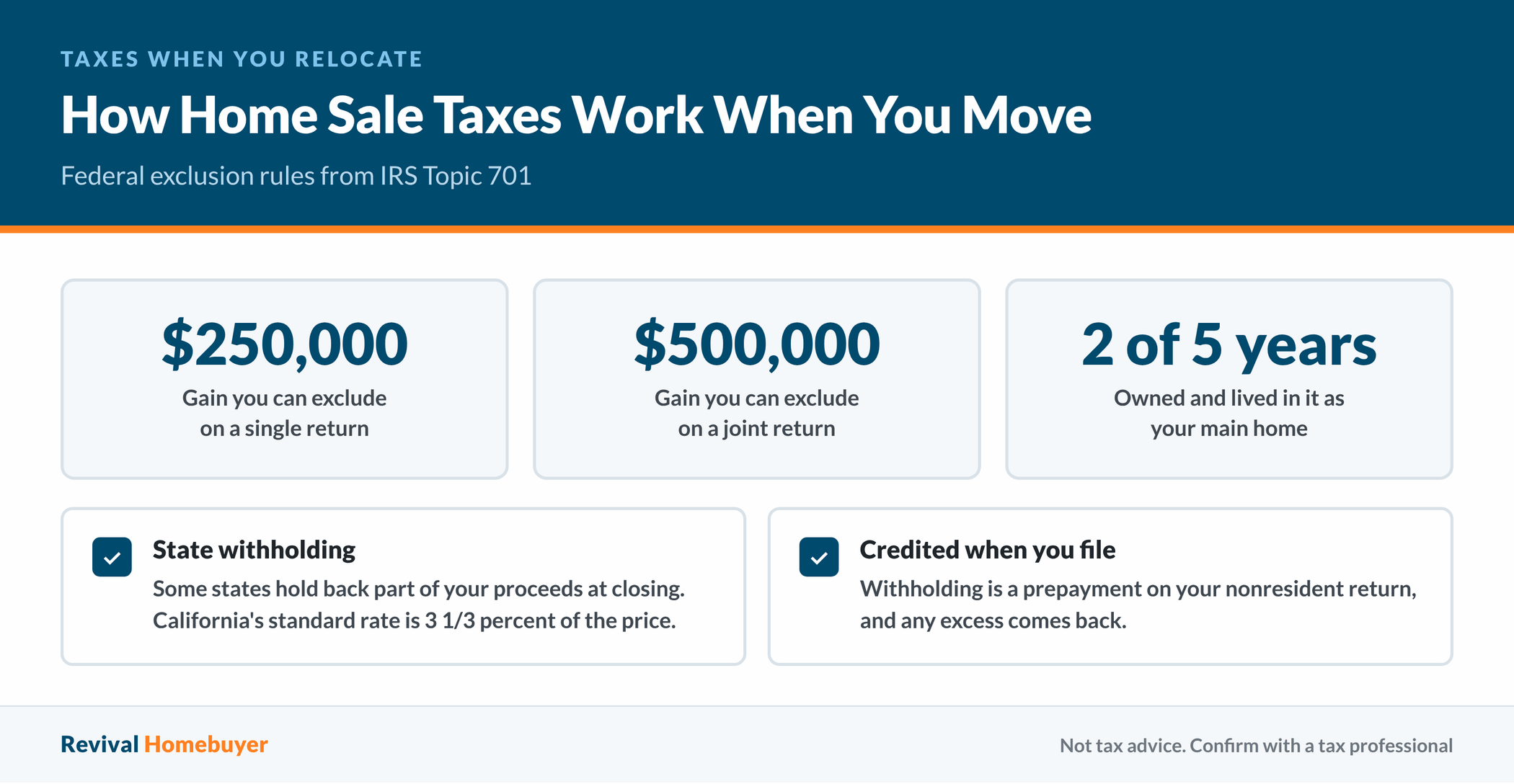
Section 121 of the tax code lets you exclude up to $250,000 of gain from the sale of your main home, or $500,000 on a joint return, per IRS Topic 701. You generally need to have owned the place and lived in it as your main home for two of the five years ending on the sale date. So a quick flip or a rental you only recently moved into won’t qualify. The exclusion applies to your profit, not your sale price. It’s also off the table if you already claimed it on another home sold within the prior two years.
The IRS allows a partial exclusion in certain situations, including work-related moves, and Publication 523 spells out the specifics. If you’re close to the line, a tax professional is worth the hour.
State taxes are the wrinkle nobody warns relocating sellers about. The state where the house sits generally has first claim on income from the sale, no matter where you’ve moved. Several states also require withholding at closing, so a chunk of your proceeds can get held back before you even see them. California is one example. Its standard withholding is 3 1/3 percent of the sales price, though a qualifying principal residence is generally exempt, according to FTB Publication 1016. Rates and exemptions differ by state, and some states have no withholding at all.
Withholding is a prepayment, credited against what you owe when you file a nonresident return, and you get any excess back. Your money is just tied up in the meantime, which matters when you’re buying in a new state.
For certainty, call your state revenue department. Confirming what applies to you costs nothing.
What Mistakes Should You Avoid When You Sell a House and Move Out of State?
Some sellers assume they’ll have to fly back to sign. Your closing doesn’t require you to be in the room.
The costliest mistake is pricing emotionally. You know what the neighbors got in 2022. Your house isn’t that house, and this isn’t that market.
Shutting off utilities is another one. A buyer’s inspector can’t test a furnace without gas, and a vacant house without heat in a cold climate invites frozen pipes. Keep service active and in your name until you’ve closed.
Disclosure obligations follow the property and the seller, and the requirements differ by state. Write down what you know about that basement seep.
Smaller ones are worth flagging too, like forgetting to cancel automatic HOA payments after closing or leaving the house under a policy that lapses on a vacancy clause. Another is signing a lease in the new state before the sale has a firm closing date.
Have you decided who holds the keys after you leave? Someone local needs access for inspections, appraisals, lawn service and the occasional emergency. Line up a neighbor, a relative, a lockbox with your agent or a property manager on retainer. Figure it out before the truck pulls away, not after.
How Do You Prepare Your House After You Move Out of State?
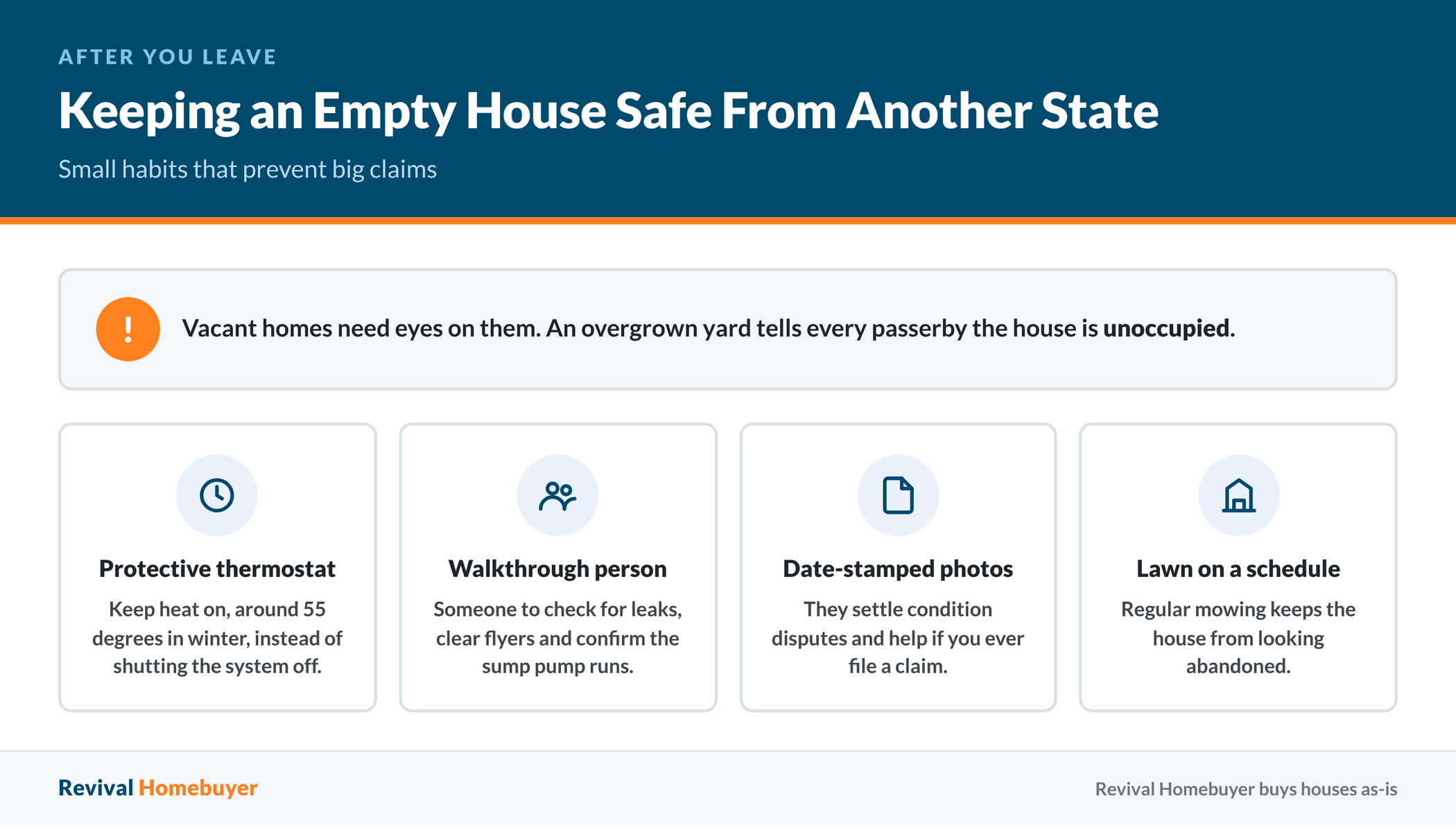
Vacant homes need eyes on them. Set the thermostat to a protective range rather than shutting the system off, around 55 degrees in winter. Have the lawn cut on a schedule, because an overgrown yard tells every passerby the house is unoccupied.
Date-stamped photos settle disputes about condition later, and they help if you ever need to file a claim.
Arrange a walkthrough person, somebody who can check for leaks, pick up flyers off the porch and confirm the sump pump still runs after a heavy rain.
A couple in Clearwater came to me mid-divorce with a house neither one wanted to manage. He’d already taken a job in another state, she was staying in the region, and the garage still held a jet ski that had become its own small argument. They didn’t want showings or negotiations. All they asked for was a number, a date and a wire to two separate accounts, and the sale got handled without either of them flying back.
Frequently Asked Questions About How to Sell House and Move Out of State
Is It Better to Move Out Before Selling a House?
It depends on how your house shows. A lived-in home with tasteful furniture usually photographs better and gives buyers a sense of scale that bare rooms don’t. If your place is cluttered or dated, moving out first and doing a deep clean can help more than staging would. The practical middle ground is leaving a handful of furnishings behind and taking the rest with you.
Can I Sell House and Move Out of State Before the Closing Date?
Yes, and plenty of sellers do. You can sign your closing documents remotely in front of a notary wherever you’ve landed, then send them back to the title company. Confirm early with your closing agent whether your state accepts remote online notarization or requires a traditional in-person notary, since that answer changes your logistics.
Do I Have to Pay Taxes in Two States If I Sell House and Move Out of State?
You may need to file in both, but you generally won’t be taxed twice on the same income. The state where the property sits typically taxes the gain, and your new state usually gives you a credit for tax paid elsewhere if it taxes income at all. Some states also hold back part of your proceeds at closing, which gets credited back when you file.
How Fast Can I Sell If I Already Have a Moving Date?
A direct cash sale can often close in two to three weeks, because there’s no lender underwriting and no appraisal to schedule. Traditional listings take longer once you add marketing time plus the buyer’s financing period. With a fixed moving date coming up soon, work backward from it and be realistic about which path fits.
What Happens If My House Doesn’t Sell Before I Relocate?
You carry it: mortgage, insurance, utilities and upkeep on a property you’re not living in. Some sellers bridge the gap with a short-term rental, though that introduces tenant rights that can complicate a later sale. Others lower the price or switch to a direct buyer to stop the bleeding, and the sooner you make that call the less it costs you.
Should I Make Repairs Before I Sell House and Move Out of State?
Only the ones that pay for themselves. Cosmetic fixes like paint and landscaping usually return more than they cost. Major work like a roof or HVAC replacement rarely returns full value, and supervising contractors remotely is its own headache. With a long repair list, get an as-is offer and compare it against a repaired-and-listed estimate to see quickly which way to go.
Tampa Homeowners Moving Out of State
Revival Homebuyer is based in Tampa and buys houses across Hillsborough, Pasco and Pinellas counties. Single-family closed sales in the Tampa Bay metro fell 16 percent from a year earlier in October 2026, according to Florida Realtors data. For Tampa sellers on a moving deadline, a cash offer gives you a firm number to compare against a listing.
We buy beyond the bay too, so homeowners elsewhere in Florida can run the same comparison with us.
Talk Through Your Move With Revival Homebuyer
If you’re facing a move and the house feels like the thing holding everything up, we’d be glad to talk it through with you. You can reach out to Revival Homebuyer for a straight answer on what your house is worth as-is and how fast it could close. No pressure, no obligation and no hard feelings if you decide listing is the better fit for your situation. Fill out the short form below to get started.